Students can use Curiosity Class 8 Science Book Solutions Chapter 12 How Nature Works in Harmony Class 8 Question and Answer as a quick reference guide.
Class 8 Science Chapter 12 How Nature Works in Harmony Question Answer
Science Class 8 Chapter 12 Question Answer How Nature Works in Harmony
How Nature Works in Harmony Class 8 Question Answer (InText)
Question 1.
Probe and Ponder (Page 190)
- How might the loss of forest cover and changes in rainfall patterns lead to elephants to enter human farms and villages?
- Imagine you are a tree in a dense forest. What kind of relationships would you have with water, sunlight, other animals, and other components of the forest?
- Do you think the Earth can thrive without humans? Can humans survive without the Earth?
- If two kinds of birds compete for the same fruit, how might their way of living change over time?
- Can human actions cause natural disasters?
- Share your questions
………………………. ?
Answer:
(Questions may vary)
(i) How does pollution in one part of the ecosystem affect others?
(ii) What role do children and schools play in protecting ecosystems?

Question 2.
Can overfishing by humans change the balance of an ecosystem? How do you think it may affect the living and non-living parts of the habitat? (Page 195)
Answer:
Yes, overfishing by humans can change the balance of an ecosystem, and it can have serious effects on both the living (biotic) and non-living (abiotic) parts of a habitat.
Effect on living parts:
- If too many fish are removed, their predators (like birds or larger fish) may have less food, and their populations may decline, affecting the food web.
- Organisms that fish feed on, like dragonfly larvae or insects, may increase in number without natural control, leading to overpopulation.
- Without fish, more dragonflies may eat pollinators (like bees and butterflies), reducing pollination and thus reducing seed production in nearby plants.
Effect on non-living parts:
- Overfishing may lead to a buildup of algae or insect larvae, possibly leading to oxygen depletion in the water.
- Fish help recycle nutrients in the water. Overfishing will disrupt this cycle, affecting plant growth.
Question 3.
Does nature really waste anything? (Page 201)
Answer:
No, nature does not waste anything. Nature works in perfect harmony, using decomposition and interconnected food webs to ensure that all materials and energy are cycled and nothing goes to waste.
Question 4.
What happens when we intervene in nature? (Page 202)
Answer:
When humans intervene in nature, it can disrupt the natural balance of ecosystems. For example:
- Cutting trees, overfishing, or hunting can reduce populations of animals and plants.
- Use of pesticides by farmers harms soil, water and human health.
- Human activities like dumping waste or constructing buildings can pollute water, soil, and air and destroy habitats for many organisms.
Question 5.
How can we stop damaging forests, rivers, and wetlands? Think about what actions you and your community can take to protect these important places. (Page 204)
Answer:
The following measures can be taken to protect places like forests, rivers, and wetlands:
- Plant and protect trees in your school, neighbourhood, or village.
- Avoid throwing garbage, plastic, or chemicals into rivers or drains.
- Do not drain or fill wetlands for construction or dumping waste.
- Form eco-clubs or student groups to promote awareness and action.
- Celebrate and support Earth Day, Wildlife Week, or World Wetlands Day with educational activities.
Question 6.
Based on your learning, what practices do you think can help farmers protect the soil, the environment, and our food security for the future? (Page 206)
Answer:
Based on our learning, the following practices can help farmers protect the soil, the environment, and ensure food security for the future:
- Farmers can use organic manure, compost, or vermicomposting to enrich the soil naturally.
- Growing different crops together (mixed cropping) help maintain soil nutrients and reduce pest attacks. This prevents the harm caused by monoculture.
- Use drip irrigation and rainwater harvesting to reduce water wastage.
- Farmers should be trained in sustainable agriculture techniques through workshops, Krishi Melas, and expert interactions.
NCERT Class 8 Science Chapter 12 Question Answer How Nature Works in Harmony (Exercise)
Keep the curiosity alive(Pages 207-208)
Question 1.
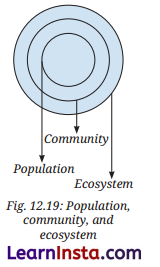
Refer to the given (Fig. 12.19) and select the wrong statement.
(i) A community is larger than a population.
(ii) A community is smaller than an ecosystem.
(iii) An ecosystem is part of a community.
Answer:
(iii) An ecosystem is part of a community.
Question 2.
A population is part of a community. If all decomposers suddenly disappear from a forest ecosystem, what changes do you think would occur? Explain why decomposers are essential.
Answer:
If all decomposers were to suddenly disappear from a forest ecosystem, major changes would occur. They are as follows:
- Dead plants, animals, and organic waste would build up on the forest floor, as there would be no decomposers (fungi, bacteria, or insects) to break them down.
- Decomposers break down dead matter and recycle nutrients. Soil would become nutrient-poor.
- Plants would struggle to grow, leading to fewer producers in the ecosystem.
- Herbivores would lack food, causing their numbers to decline.
- Carnivores and omnivores would also suffer as their prey disappears.
- The lack of decomposition would disrupt the balance of interactions, leading to increased disease from decaying matter.
Decomposers are essential because they play an important role in recycling nutrients. They return nutrients like nitrogen to the soil, which are vital for plant growth. They break down complex organic matter into simpler substances. They help maintain the balance of ecosystems by ensuring that nothing is wasted and everything is reused in nature.
Question 3.
Selvam from Cuddalore district, Tamil Nadu, shared that his village was less affected by the 2004 Tsunami compared to nearby villages due to the presence of mangrove forests. This surprised Sarita, Shabnam, and Shijo. They wondered if mangroves were protecting the village. Can you help them understand this?
Answer:
Yes, Selvam is correct. Mangrove forests played a major role in protecting his village during the 2004 tsunami. Mangrove roots protect us by slowing down strong winds and waves during storms and floods, including tsunamis. The trees also absorb carbon dioxide from the air and release oxygen. This reduces the height and impact of the water when it reaches the shore. Their complex root system holds the soil tightly, preventing soil erosion.
Question 4.
Look at this food chain:
Grass → Grasshopper → Frog → Snake
If frogs disappear from this ecosystem, what will happen to the population of grasshoppers and snakes? Why?
Answer:
If frogs disappear from this ecosystem, the population of grasshoppers and snakes will become unbalanced.
Frogs are natural predators of grasshoppers. Without frogs to eat them, grasshoppers would reproduce more freely, and their numbers would rise. This could lead to overgrazing of grass, harming plant life.
Grass → Grasshopper → Frog → Snake
Snakes depend on frogs for food. Without frogs, snakes will struggle to find enough frogs to eat, and their population would decline over time due to starvation or migration.
This shows how every organism plays a crucial role in maintaining the health of an ecosystem.
Question 5.
In a school garden, students noticed fewer butterflies the previous season. What could be the possible reasons? What steps can students take to have more butterflies on campus?
Answer:
If students noticed fewer butterflies in the school garden the previous season, it could be due to several environmental factors or human activities. The reasons could be:
- Extreme weather (unusual rain, heat, or wind) can affect butterfly breeding and feeding.
- Butterflies need nectar from flowers. A lack of colourful, nectar-rich flowers reduces food availability, leading to fewer butterflies.
- Spraying chemicals can harm both adult butterflies and their caterpillars.
Students can take the following steps to attract more butterflies:
- Plant flowering plants like marigold, hibiscus, which are rich in nectar.
- Encourage the school to go pesticide-free, especially in garden areas.
- Include plants like milkweed, curry leaf, or citrus plants that butterflies use to lay eggs.
- Place shallow dishes or wet sand/mud patches where butterflies can drink water.
Question 6.
Why is it not possible to have an ecosystem with only producers and no consumers or decomposers?
Answer:
All three types of organisms-producers, consumers, and decomposers-are essential for maintaining the balance of life and energy flow in an ecosystem. Producers (such as green plants) make up the first trophic level, consumers (like deer and goats) are at the second, while decomposers operate on each trophic level.
Producers alone cannot sustain the ecosystem. If there are no consumers to eat plants, they will grow uncontrollably and then eventually die due to a lack of space and other resources. Consumers (herbivores, carnivores, omnivores) feed on plants or other animals. Without them, there is no one to control plant or prey populations.
Decomposers break down complex substances in dead plants and animals into simpler ones. This process returns important nutrients to the soil. Without them, dead matter and waste would accumulate. Soil would lose nutrients, and plants would stop growing over time. Hence, it is not possible to have an ecosystem with only producers and no consumers or decomposers.
Question 7.
Observe two different places near your home or school (e.g., a park and a roadside). List the living and non-living components you see. How are the two ecosystems different?
Answer:
The living and non-living components are given as:
| Park Ecosystem | Roadside Ecosystem | ||
| Living | Non-living | Living | Non-living |
| components | components | components | components |
| Trees | Soil | Few plants, shrubs | Vehicles |
| Grass | Water | Stray dogs | Sunlight |
| Plants | Sunlight | Cats | Street light |
| Birds | Air | Monkeys | Electric poles |
| Squirrels | Bench | Birds | Stones |
| Human | Mats | Flies | |
| Butterflies | Mosquitoes | ||
| Bees | |||
| Ants | |||
The park is a healthier, greener ecosystem with more biodiversity and better environmental conditions, while the roadside has limited life and is more affected by human disturbance and pollution.
Question 8.
‘Human-made ecosystems like agricultural fields are necessary, but they must be made sustainable.’ Comment on the statement
Answer:
Human-made ecosystems like agricultural fields are necessary, as they provide food, raw materials, and livelihoods for millions of people. However, to protect the environment and ensure long-term productivity, they must be made sustainable.
Sustainable farming protects soil, water, biodiversity and ensures that agriculture remains productive for generations.
Question 9.
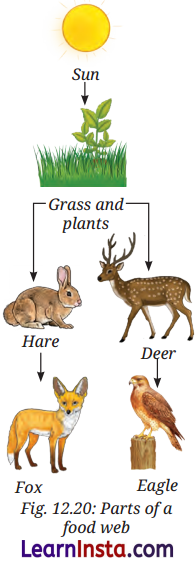
If the Indian hare population (Fig. 12.20) drops because of a disease, how would it affect the number of other organisms?
Answer:
If the Indian hare population drops due to a disease, it would affect the entire food web in the following ways:
- Hares, being herbivores, are prey for the predators (carnivores). With fewer hares, these predators will have less food. Their population may decline, or they may shift to other prey, disturbing the entire balance further.
- Hares feed on grasses and plants. With fewer hares, less grazing occurs, and this may increase the plant population.
- Predators may start hunting mice or deer, causing a decline in those populations, affecting the balance.
This illustrates how interconnected and delicate ecosystems are, where any change in one species affects many others.
Class 8 How Nature Works in Harmony Question Answer (Activities)
Activity 12.1: let us explore (pages 191-192)
Aim: To observe and record living and non-living components of two nearby habitats.

Answer:

Observation and conclusion: Different habitats provide specific conditions required for organisms to survive.
- A pond provides food, oxygen, and shelter. Fish get food from small plants and animals, and they obtain oxygen from the water.
- A forest provides space to live, trees for shelter, and plants for food. For example, monkeys live in forests where they can climb trees and find fruits to eat.
- In every habitat, all living organisms interact with each other and with the non-living components of their environment.
Activity 12.2: let us record (pages 193-194)
Aim: To observe and record the populations of different kinds of organisms in a single habitat.
Answer:
Do it yourself.
Activity 12.3: let us read (pages 194-195)
Aim: To find out the role of different organisms and their interactions in a community.

Observation and conclusion: Pond A had fewer dragonflies because fish eat their larvae. This allowed more bees and butterflies to thrive, improving pollination and increasing flowering plants. In pond B , the absence of fish led to more dragonflies. This study shows how biotic and abiotic components interact and influence each other in an ecosystem.
Activity 12.4: Let Us Relate And Identify (Page 196)
Aim: To identify and understand the different types of interactions between biotic and abiotic components in a habitat.
(Refer to Table 12. 3)
Do it yourself.

Activity 12.5: Let Us Classify (Pages 197-198)
Aim: To classify organisms in a forest ecosystem based on their feeding habits.

Answer:
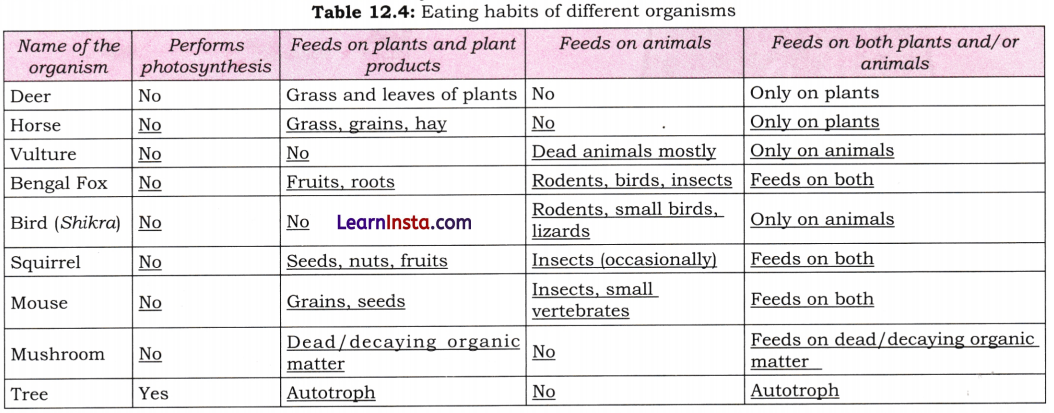
Observation and conclusion: Plants make their food through the process of photosynthesis. Thus, they are called autotrophs. Organisms that cannot produce their food and depend on other organisms for their food are called consumers or heterotrophs. Organisms that eat only plants are called herbivores, such as deer and hares. Those that eat only animals are carnivores, such as the leopard. Organisms that eat both plants and animals are omnivores, such as crows, foxes, and mice.
Activity 12.6: Let Us Link (Relate) (Page 199)
Aim: To understand and link the feeding relationships among organisms in a given ecosystem.
(i) Grass →Hare →Fox
(ii) Grass →Grasshopper →Frog →Eagle
(iii) Grass →Grasshopper →Snake →Eagle
(iv) Grass →Grasshopper →Frog
(v) Grass →Grasshopper →Snake
(vi) Grass →Hare →Eagle
(vii) Frog →Snake
(viii) Snake →Eagle
(ix) Fox →Eagle (optional depending on predation behaviour)
Observation and conclusion: The interactions between biotic components based on feeding relationships can be represented in the form of a linear chain. A food chain is a simple sequence showing ‘who eats whom’ in an ecosystem.
Activity 12.7: Let Us Draw (Pages 199-200)
Aim: To understand trophic levels by representing the feeding relationships in a crop field as an ecological pyramid.
The table is given as:
| Organisms | Number |
| Millets | 54 |
| Mouse | 15 |
| Eagle | 01 |

Observation and conclusion: Each organism in a food chain has a specific position, called a trophic level. On arranging the numbers in ascending order, the highest number is at the base and the lowest is at the top.

Answer:

We can conclude that:
- Producers (like millets) are at the first trophic level.
- Herbivores (like mice) are at the second level.
- Carnivores (like eagles) occupy the next level.
Activity 12.8: Let Us Trace And Link (Page 200)
Aim: To trace and link feeding relationships to understand how food chains connect and form a food web.
Observation and conclusion: Each of the organisms may be eaten by two or more types of organisms. Thus, in an ecosystem, the food chains are interlinked with each other to form a network, called a food web.

Activity 12.9: Let Us Read (Page 202)
Aim: To understand the impact of overharvesting on frog populations and its effects on the ecosystem and environment.
Do it yourself.
Activity 12.10: Let Us Survey (Pages 205-206)
Aim: To explore farming practices and their effects by interviewing local farmers.
Do it yourself.