These Class 7 Science Curiosity Worksheet and Class 7 Science Chapter 5 Changes Around Us Physical and Chemical Worksheet with Answers are excellent for board exam practice.
Class 7 Science Chapter 5 Changes Around Us Physical and Chemical Worksheet
Class 7 Changes Around Us Physical and Chemical Worksheet
Worksheet On Changes Around Us Physical and Chemical Class 7 – Changes Around Us Physical and Chemical Worksheet Class 7
A. Multiple-Choice Questions
Question 1.
Which of these is not required for combustion?
(a) Fuel
(b) Oxygen
(c) Heat
(d) Water
Question 2.
Which of these changes does not involve a chemical reaction?
(a) Ripening of fruit
(b) Boiling water
(c) Lighting a match
(d) Exploding fireworks

Question 3.
Which process leads to the formation of soil from rocks?
(a) Erosion
(b) Combustion
(c) Weathering
(d) Melting
Question 4.
The question consists of an Assertion (A) and a Reason (R). Read the Assertion and Reason and choose the appropriate answer.
Assertion (A): Bioluminescence in fireflies is a chemical change.
Reason (R): Light is emitted as a result of a chemical reaction inside the body.
(a) Both A and R are true, and R is the correct explanation of A.
(b) Both A and R are true, and R is not the correct explanation of A.
(c) A is true but R is false.
(d) A is false, but R is true.
Question 5.
The question consists of an Assertion (A) and a Reason (R). Read the Assertion and Reason and choose the appropriate answer.
Assertion (A): Rusting of iron is an undesirable change.
Reason (R): It weakens the iron objects and cannot be reversed.
(a) Both A and R are true, and R is the correct explanation of A.
(b) Both A and R are true, and R is not the correct explanation of A.
(c) A is true but R is false.
(d) A is false, but R is true.
B. State True (T) or False (F).
1. Melting of ice is a chemical change.
2. A synthetic blanket is safe to use to put off a fire on a person’s clothes.
3. Spoiling of fruits is an example of a desirable and irreversible chemical change.
4. Calcium carbonate is commonly known as lime water.
5. Carbon dioxide is released when lemon juice reacts with baking soda.
C. Fill in the blanks.
1. When carbon dioxide is passed through lime water, it turns milky. This is a ____________ change.
2. The movement of soil or rock by wind or water is known as ____________, and it is a ____________ change.
3. Substances like wood, paper, and cotton are examples of ____________ substances.
4. Mixing baking soda with vinegar produces ____________, showing a ____________ change.
5. Deposition of sediments in rivers over time is a slow and ____________ change.
D. Assign one word to the following terms.
1. A gas that supports burning. ____________
2. Black coloured rock containing iron. ____________
3. A sound produced when baking soda reacts with vinegar. ____________
4. A white powder obtained when magnesium reacts with air. ____________
5. A change that is useful in our daily life. ____________
E. Match Column I with Column II.
| Column I | Column II |
| (i) Curdling of milk | (a) Bioluminescence |
| (ii) Burning of magnesium ribbon | (b) Weathering |
| (iii) Soil formation | (c) Combustion |
| (iv) Light from a firefly | (d) Chemical change |
F. Identify whether the pictures depict physical or chemical changes and match them accordingly.
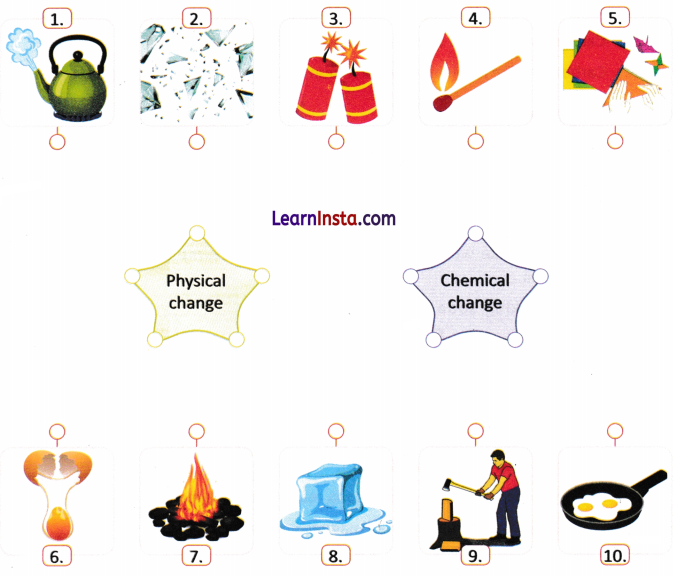
Wonder Why?
A. Give reasons for the following.
Question 1.
If a person’s clothes catch fire, we wrap a blanket around the person and not a synthetic cloth.
____________________________________________________________
____________________________________________________________
Question 2.
Fireflies glow in the dark, but butterflies do not.
____________________________________________________________
____________________________________________________________
Question 3.
Tearing of paper is a physical change, whereas burning of paper is a chemical change.
____________________________________________________________
____________________________________________________________
Question 4.
A piece of wood does not burn in a vacuum.
____________________________________________________________
____________________________________________________________
Question 5.
A candle stops burning when covered with a glass jar.
____________________________________________________________
____________________________________________________________
Question 6.
The rocks in the river become smoother with time.
____________________________________________________________
____________________________________________________________
B. Mention the colour of the compounds given below.
1. Iron oxide ____________________________________________________________
2. Calcium carbonate ____________________________________________________________
3. Magnesium oxide ____________________________________________________________
4. Basalt ____________________________________________________________
C. Read the paragraph and answer the following questions.
Soham was doing an activity at his home to see if any change occurred or not. He poured some vinegar into a bottle. Then, he filled a balloon with some baking soda and attached the balloon to the mouth of the bottle, such that the baking soda falls into the bottle. He then left the bottle undisturbed for a few minutes to see the result.

Question 1.
What did Soham observe?
____________________________________________________________
____________________________________________________________
Question 2.
Why did this happen?
____________________________________________________________
____________________________________________________________
Question 3.
Is the change seen in the balloon a physical or chemical change?
____________________________________________________________
____________________________________________________________
Question 4.
Write a possible equation for this observation.
____________________________________________________________
____________________________________________________________
Question 5.
What will happen if vinegar is replaced by lemon juice?
____________________________________________________________
____________________________________________________________
Learn By Doing
Ayan wants to explain the concept of combustion to his younger brother. So, he took a cotton ball and dipped it in water, then tried to burn it. He then took a dry cotton ball and tried to burn it. Now, answer the following questions based on his experiment.
Question 1.
What is Ayan trying to explain to his brother?
____________________________________________________________
____________________________________________________________
Question 2.
Fill in the table below.

Question 3.
What prevents the wet cotton from catching fire?
____________________________________________________________
____________________________________________________________
Question 4.
What are the essential conditions for combustion to occur?
____________________________________________________________
____________________________________________________________
Explore With Curiosity
A. Given below is a list of daily activities that we commonly observe or do in our daily lives. Look at each example and identify whether the change can be reversed or not. Tick (✓) if it can be reversed and cross (✗) if it cannot be reversed in the respective column. Give a reason for your answer.

B. Look at the picture given below. Analyse what students are discussing about the burning candle and fill in the blanks using the hints given below.

C. Identify the type of change as Desirable or Undesirable, and tick (✓) in the correct column in the following table.

Word Puzzle
Complete the crossword with the help of the given clues.

DOWN
1. Kitchen acid that reacts with baking soda
2. It needs fuel, heat, and air to burn
3. Change in rocks that leads to the formation of soil
8. Gas required for combustion
ACROSS
4. Changes we want or are useful to us
5. Brown flaky coating on iron
6. A white classroom object breaks physically but stays the same chemically
7. Gas that turns lime water milky
Activities
A. Take some iron nails and bring them close to a magnet to observe their magnetic property. Now, take a container and keep some moist cotton at the base. Put the iron nails on the cotton and leave the iron nails undisturbed in an open area for a few days. After a few days, you see a layer formed over the iron nails. Again, bring the magnet near the iron nails. Write the changes that you observed in your notebook and the possible reason that may have caused the change.
B. Take two balloons and fill them with air. Label them as Balloon I and Balloon II. Now, try to pop Balloon I with a pointed needle and burn Balloon II carefully using a flame. Observe the difference in both cases and fill in the table given below. Also, write a conclusion based on your observation.
