Students can access the CBSE Sample Papers for Class 12 Biology with Solutions and marking scheme Set 3 will help students in understanding the difficulty level of the exam.
CBSE Sample Papers for Class 12 Biology Set 3 with Solutions
Time Allowed: 3 hours
Maximum Marks: 70
General Instructions:
- All questions are compulsory.
- The question paper has five sections and 33 questions. All questions are compulsory.
- Section – A has 16 questions of 1 mark each; Section – B has 5 questions of 2 marks each; Section – C has 7 questions of 3 marks each; Section – D has 2 case-based questions of 4 marks each; Section – E has 3 questions of 5 marks each.
- There is no overall choice. However, internal choices have been provided in some questions. A student has to attempt only one of the alternatives in such questions.
- Wherever necessary, neat and properly labeled diagrams should be drawn.
Section – A(16 Marks)
Question 1.
Which of the following represents the male gametophyte in flowering plants?
(A) Stamen
(B) Anther
(C) Pollen sac
(D) Pollen grain
Answer:
(D) Pollen grain
Explanation: In flowering plants, the male gametophyte is the pollen grain and the female gametophyte is the embryo sac.
Question 2.
Method to assist infertile couple to have children:
(A) Gamete intrafallopian transfer
(B) Amniocentesis
(C) Tubectomy
(D) Use of contraceptives.
Answer:
(A) Gamete intrafallopian transfer
Explanation: Gamete intrafallopian transfer (GIFT) is one of the methods that help infertile couples to have children.

Question 3.
A DNA molecule is 160 base pairs long. If it has 20% adenine, how many cytosine bases are present in this DNA molecule?
(A) 48
(B) 64
(C) 96
(D) 192
Answer:
(C) 96
Explanation: According to Chargaffs rule, the double-stranded DNA molecule, globally has percentage base-pair equality: %A = %T and %G = %C.
Total number of base pairs = 160
Total bases = 160 × 2 = 320
Amount of adenine (in %) = 20 %
Number of adenine bases = 20% × 320
Number of adenine = 64
Thus, the number of thymine = 64
This means, A + T = 64 + 64 = 128 base
Now, left over bases i.e.,
G + C = Total bases – (A + T)
= 320 – 128 = 192
Or Cytosine = 192/2 = 96 bases
Question 4.
Sutton and Boveri conducted experiments to understand the pattern of inheritance of traits in organisms. Which among the following statements was /were understood as a result of experiments by Sutton and Boveri?
1. Genes are located on homologous chromosomes.
2. All genes on the same chromosome are linked.
3. Genes on homologous chromosomes get separated during anaphase of meiotic division.
4. Frequency of gene pairs on the same chromosome is a measure of the distance between the genes.
(A) only 1
(B) only 1 and 3
(C) only 2, 3 and 4
(D) only 1, 3 and 4
Answer:
(B) only 1 and 3
Explanation: Sutton and Boveri concluded that genes are located on homologous chromosomes and genes on homologous chromosomes get separated during anaphase of meiotic division.
Question 5.
Which of the following is used as an atmospheric pollution indicator?
(A) Lepidoptera
(B) Lichens
(C) Lycopersicon
(D) Lycopodium
Answer:
(B) Lichens
Explanation: Lichens grow in an area which is not polluted, as lichens do not possess roots and air is their primary source for most elements. Hence, Lichens are used as an atmospheric pollution indicator. Lepidoptera are insects that include butterflies and moths.
Lycopersicon is a genus the in flowering plant family and contains 13 species of tomato groups. Lycopodium is a genus of dub mosses.
Question 6.
Analogous organs arise due to:
(A) Divergent evolution
(B) Artificial selection
(C) Genetic drift
(D) Convergent evolution
Answer:
(D) Convergent evolution
Explanation: The organs which have similar functions but are different in their structural details and origin are called analogous organs. The analogous structures are the results of convergent evolution.
Question 7.
Meselson and Stahl’s experiment proved:
(A) Transduction
(B) Transformation
(C) DNA is the genetic material
(D) Disruptive DNA replication
Answer:
(D) Disruptive DNA replication
Explanation: Meselson and Stahl performed the experiments on the DNA and proved that DNA is semi-conservation or disruptive type. The experiment used the radioactively labelled N14. This labelled nitrogen atom helps to detect and analyses the replication pattern. The new strand is formed by using one of the old strands as a template.
Question 8.
A normal visioned woman, whose father is colour blind, marries a normal visioned man. What would be the probability of her daughters to the colour blind?
(A) All daughters have normal vision
(B) 50% of daughters have colour blind
(C) All daughters have colour blind
(D) Data insufficient
Answer:
(A) All daughters have normal vision
Explanation: Since the father of the woman is colour blind, the woman would be a carrier of the trait. If she marries a normal vision man, then by the method of Punnett square, we can say that half of the boys will be colour blind, half boys will have normal vision and half of the girl will be carriers and another half would not have the colourblind gene. However, all girls will be phenotypically normal.
Question 9.
Hemozoinis:
(A) A precursor of haemoglobin
(B) A toxin from Streptococcus
(C) A toxin from Plasmodium species
(D) A toxin from Haemophilus species
Answer:
(C) A toxin from Plasmodium species
Explanation: Haemozoin is a toxin released by Plasmodium species, which is responsible for the chill and high fever recurring every three to four days.
Question 10.
Which one of the images of the replicating fork given below represents the process correctly?

Answer:

Explanation: Synthesis of DNA by DNA polymerase occurs only in 5 → 3 direction. One strand called the leading strand, is copied in the same direction as the unwinding helix. The other strand is known as the lagging strand. Replication of the lagging strand is in discontinuous way, and the direction of growth of the lagging stand is 3 → 5 though in short segments of DNA which is always in the 5 → 3 directions. These short segments are called Okazaki fragments joined together by the action of DNA ligase.
Question 11.
A biotechnologist wanted to create a colony of E.coli possessing the plasmid pBR322, sensitive to tetracycline. Which one of the following restriction sites would he use to ligate a foreign DNA?
(A) Sail
(B) Pvu I
(C) EcoRI
(D) Hind III
Answer:
(A) Sail
Explanation: Since the Tetracycline resistance gene has two restriction sites, namely Bam HI and Sal I, the foreign DNA can be ligated at any of these two sites.
Question 12.
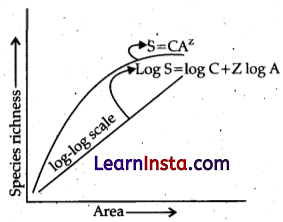
The given graph shows Species-Area relationship. What will be the equation of curve a and b.

(A) Equation a: S = CAZ
Equation b: Log S = Log C + Z Log A
(B) Equation a: S = CZA
Equation b: Log S = Log C + Z Log A
(C) Equation a: C = SAZ
Equation b: Log C = Log S + A Log Z
(D) Equation a: S = ACZ
Equation b: Log S = Log A + Z Log C
Answer:
(A) Equation a: S = CAZ
Equation b: Log S = Log C + Z Log A
Explanation: The equation for ‘a’ and ‘b’ is S = CAZ and Log S = Log G + Z Log A respectively.
Question No. 13 to 16 consist of two statements- Assertion (A) and Reason (R). Answer these questions by selecting the appropriate option given below:
(A) Both A and R are true and R is the correct explanation of A.
(B) Both A and R are true and R is not the correct explanation of A.
(C) A is true but R is false.
(D) A is false but R is true.
Question 13.
Assertion (A): In human male, testes are extra-abdominal and lie in scrotal sacs.
Reason (R): Scrotum protects the testes.
Answer:
(A) Both A and R are true and R is the correct explanation of A.
Explanation: The scrotum is a bag-like structure that protects the testicles. Testicles make sperm and for this, they need to be cooler than the inside of the body. This is why the scrotum is located outside the body.
Question 14.
Assertion (A): The nucleosome is a repeating unit of a structure in nucleus called chromatin.
Reason(R): The negatively charged DNA is wrapped around the positively charged histone octamer to form a structure called nucleosome.
Answer:
(B) Both A and R are true and R is not the correct explanation of A.
Explanation: The length of DNA in a human diploid cell is around 2.2 metres. It is greater than the dimension of a typical nucleus. In order to fit them in the nucleus, DNA is wrapped around histone octamer to form a nucleosome. The nucleosome in chromatin gives a ‘beads’ on string appearance.
Question 15.
Assertion (A): Activated sludge should have the ability to settle quickly.
Reason (R): This is to be done to absorb pathogenic bacteria present in waste water while sinking to the bottom of the settling tank.
Answer:
(C) A is true but R is false.
Explanation: Activated sludge should have the ability to settle quickly so that it can be rapidly pumped back from sedimentation tank to aeration tank.
Question 16.
Assertion (A): Norman E. Borlaug was the father of “Green revolution”.
Reason (R): Green revolution is the period when there is significant increase in agricultural productivity of grains (specially wheat and rice).
Answer:
(A) Both A and R are true and R is the correct explanation of A.
Explanation: Green revolution refers to a process that increases the production of food grains. Prof. Norman E. Borlaug developed high-yielding varieties of wheat resistant to diseases like rust.
Section – B(10 Marks)
Question 17.
Name the hormones involved in the regulation of spermatogenesis.
Answer:
Follicle-stimulating hormones (FSH) and luteinising hormones (LH) are secreted by gonadotropin releasing hormones from the hypothalamus. These hormones are involved in the regulation of the process of spermatogenesis. FSH acts on Sertoli cells, whereas LH acts on Leydig cells of the testis and stimulates the process of spermatogenesis.
Question 18.
Carefully examine structures A and B of pentose sugar given below.

Which one of the two is more reactive? Give reasons.
Answer:
A is more reactive
2′-OH group present in the pentose sugar
makes it more labile/catalytic and easily degradable.
Question 19.
Identify A, D, E and F in the diagram of an antibody molecule given below:

Answer:
A-antigen binding site,
D-light chain
E-heavy chain (constant region)
F-disulphide bond
Question 20.
Given below is the figure of an important technique of plant biotechnology. Based on it answer the following questions.

(a) Name the technique described in the figure.
(b) Define callus.
(c) Name the growth hormone used for initiating rooting.
(d) Define the term Totipotency.
Answer:
(a) Plant tissue culture.
(b) Unorganised mass of parenchymatous cells is known as callus
(c) Auxin.
(d) Totipotency is the ability of a single cell to divide and produce all of the differentiated cells in an organism.
Question 21.
Substantiate by giving two reasons as to why a holistic understanding of the flora and fauna of the cropland is required before introducing an appropriate biocontrol method.
Answer:
Eradication of pests will, disrupt predator-prey relationships, where beneficial predatory and parasitic insects which depend upon flora and fauna as food or hosts, may not be able to survive.
Holistic approach ensures that various life forms that inhabit the field, their life cycles, patterns of feeding and the habitats that they prefer are extensively studied and considered.
OR

(a) Which of the above represents the increase or decrease in population?
(b) If N is the population density at time t, then what would be its density at time (t + 1)? Give the formula.
(c) In a barn there were 30 rats. 5 more rats enter the barn and 6 out of the total rats were eaten by the cats. If 8 rats were born during the time period under consideration and 7 rats left the barn, find out the resultant population at time (t + 1).
(d) If a new habitat is just being colonised, out of the four factors affecting the population growth which factor contributes the most?
Answer:
(a) (a) and (d) represent an increase in population and (b) and (c) represent a decrease in population.
(b) Nt+1 = Nt + [(B + I) – (D + E)]
(c) Here Nt = 30; I = 5; E = 7; D = 6; B = 8
Putting the value in
Nt+1 = Nt + [(B + I) – (D + E)]
Nt+1 = 30 + [(8 + 5) – (6 + 7)]
= 30 + [13 – 13]
= 30 + 0 = 30 rats
(d) Immigration contributes the most.
Section – C(21 Marks)
Question 22.
With reference to the given schematic representation of
(a) Spermatogenesis and (b) Oogenesis, answer the following questions:

(a) About 300 million spermatozoa may be present in a human male ejaculation at one time. Calculate how many spermatocytes will be involved in producing 300 spermatozoa.
(b) How many chromatids are found during oogenesis in (i) Primary oocyte and (ii) First polar body in a human female?
Answer:
(a) Each primary spermatocyte will undergo meiosis – I and meiosis II, which will result in four spermatozoa.
300 million/4=75 million
(b) Since replication has occurred by this stage 46 × 2 = 92 chromatids Meiosis – I is completed by this time.
So, 92/2 = 46 chromatids
Question 23.
Medically it is advised to all young mothers that breastfeeding is the best for their newborn babies. Do you agree? Give reasons in support of your answer.
Answer:
Breast feeding is important for newborn babies because breast milk has valuable immunoglobulin which improves the immune power of the newborn. It has a good amount of IgA initially along with water, fat, carbohydrates, protein, vitamins and minerals, amino acids, enzymes, and white cells.
Yes, I agree with the statement.
(i) Breastfeeding provides nutrition (carbohydrates, fats, minerals such as calcium and some proteins) to the new born babies.
(ii) It also provides passive immunity to the newborn by producing antibodies such as IgA in the colostrum.
(iii) The milk is easily digested- no constipation, diarrhoea.
Question 24.
Reproductive and Child Healthcare (RCH) programmes are currently in operation. One of the major tasks of these programmes is to create awareness amongst people about the wide range of reproduction related aspects.
As this is important and essential for building a reproductively healthy society.
(a) “Providing sex education in schools is one of the ways to meet this goal. Give four points in support of your opinion regarding this statement.
(b) List any two ‘indicators’ that indicate a reproductively healthy society
Answer:
(a) Provide the right information to the students the discourage children from believing in myths and misconception about sex-related aspects.
(i) Proper information about reproductive organs
(ii) Proper information about adolescence and related changes
(iii) Safe hygienic practices
(iv) Available birth control options
(v) Care of pregnant mothers
(vi) Postnatal care
(vii) Importance of breast-feeding
(viii) Awareness of problems due to uncontrolled population growth.
(b) Better awareness about sex-related matters / increase the number of assisted deliveries / better postnatal care/decrease in IMR (Infant Mortality Rate) / decrease MMR (Maternal Mortality Rate)/increase the number of couples with small families / better detection and cure of STDs / overall increased medical facilities for sex-related problems / total well being in all aspects of reproduction/ physical – behavioural – social / physically and functionally normal reproductive organs / normal emotional and behavioural interaction among all sex related aspects.
Question 25.

(a) State the hypothesis that S.L. Miller tried to prove in the laboratory with the help of the set up given above.
(b) Name the organic compound observed by him in the liquid water at the end of his experiment.
(c) A scientist simulated a similar set up and added CH4, NH3 and water vapour at 800°C. Mention the important component that is missing in his experiment?
Answer:
(a) Chemical evolution: First form of life originated from pre-existing non-living organic molecules.
(b) Amino acids
(c) H2
Question 26.
Describe how do ‘floes’ and ‘activated sludge’ help in sewage treatment.
Answer:
Floes: Aerobic microbes consume the major part of the organic matter in the effluent, which significantly reduces BOD.
Activated sludge: Small part of activated sludge is used as inoculum and pumped back to aeration tank / pumped into anaerobic sludge digesters where microbes or bacteria grow anaerobically to produce CH4 or H2S or CO2 or biogas.
Question 27.
The image below depicts the result of gel electrophoresis.

If the ladder represents the sequence length upto 3000 base pairs (bp):
(a) Which of the bands (I – IV) correspond to 2500 bp and 100 bp respectively?
(b) Explain the basis of this kind ofseparationand also mention the significance of this process.
Answer:
(a) Band m corresponds to 2500 bp (base pairs) and Band IV corresponds to 100 bp.
(b) The fragments will resolve according to their size. The shorter sequence fragments would move farthest from well as seen in Band IV (100 bp) which is lighter as compared to Band III which is heavier being 2500 base pairs.
The significance of electrophoresis is to purify the DNA fragments for use in constructing recombinant DNA by joining them with cloning vectors.
OR
When the gene product is required in large amounts, the transformed bacteria with the plasmid inside the bacteria are cultured on a large scale in an industrial fermenter which then synthesises the desired protein. This product is extracted from the fermenter for commercial use
(a) Why is the used medium drained out from one side while the fresh medium is added from the other? Explain.
(b) List any four optimum conditions for achieving the desired product in a bioreactor.
Answer:
(a) To maintain the cells in their physiologically most active log/exponential phase.
(b) Temperature, pH, substrate, salts, vitamins, oxygen.
Question 28.
Analyse the effects of ‘Alien species invasion’ on the biodiversity of a given area. Provide two examples.
Answer:
Introduction of alien species causes decline or extinction of indigenous species due to tough competition for utilisation of resources.
Examples: Introduction of Nile perch in Lake Victoria led to the extinction of more than 200 spedes erf Cichlid fish / Introduction of African catfish (Glorias gariepinus) for aquaculture poses threat to indigenous catfish/ Threat posed to native spedes by invasive exotic weeds like carrot grass (Barthenium) / Lantana and water hyacinth (Eichhornia) /Extinction of Abingdon tortoise by the introduction of goat.
Section – D(8 Marks)
Question 29.
Cloning of genes, plays a very significant role in the genetic engineering, helping the transfer of desirable foreign genes into different hosts. The scientists, to make this process easier and effective are creating engineered vectors in such a way that they help easy linking of foreign DNA and selection of recombinants from non recombinants.’pBR322′ is one such engineered vector developed by scientists.
A diagram of an engineered vector pBR322 is given:

(a) Identify the host of this doning vector.
(b) Identify ‘Rop’ and ‘Ori’ in the diagram from ‘U’, ‘V’/W’, X, ‘Y’ and ‘Z’.
OR
(b) Write the functions of Rop and ori.
(c) Draw the fragments that will be formed by the action of’ Z’ (marked in the diagram) on the specific site of the DNA segment given below:
5′ — GTACGAATCCTGA — 3′
3′ — CATGCTTAGGACT — 3′
Answer:
(a) E.coli is the host of this cloning vector.
(b) Rop is W and Ori is U.
OR
(b) Function of Rop – To code for proteins that are involved in the replication of plasmid.
Function of Ori – It is the sequence from where replication starts and any piece of DNA when linked to this sequence can be made to replicate within the host cells.
(c) Z is EcoRI. It cuts between G and A bases at the 5′ end within the recognition sequence.
5′ —GAATTC—3′. So if the given sequence is treated with EcoRI, then the fragments generated will be:
5′ —GTACG AATTCCTGA—3′
3′ —CATGCTTAA GGACT—5′
Question 30.
Diagrammatic representation of quantitative data of different trophic levels of an ecosystem forms the ecological
pyramids. They are of three types:
(i) Number of individuals/ unit area
(ii) Biomass value and
(iii) Energy content
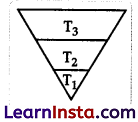
The pyramids of number or biomass may be upright or inverted depending upon the nature of trophic levels. Look at the picture given below and answer the questions:
(a) The given pyramid depicts which ecosystem? Give reason.
(b) Plants → Autotrophs, Animals → Heterotrophs, Microbes →?
State how microbes accomplish their energy requirements.
(c) Why is the number of trophic levels in an ecosystem limited?
OR
(c) Name any two things which ecological pyramids show.
Answer:
(a) The given diagram of the pyramid shows tree ecosystem, because it is an inverted pyramid. In a tree ecosystem, a tree supports hundreds of herbivorous birds; these birds carry a large number of parasites, which further carry a large number of bacteria, fungi, etc. Thus, an inverted pyramid.
(b) Microbes → Saprophytes. They derive their energy from the remains of dead organic matter of animals and plants, wherein the digestion is extracellular.
(c) There are no more than four trophic levels because energy and biomass decrease from lower to higher levels.
OR
(c) The ecological pyramids show:
(i) The amount of organisms.
(ii) The mass of all the organisms in each level.
(iii) The amount of energy at each level.
Section – E(15 Marks)
Question 31.
(a) The given diagram shows the human male reproductive system (one side only).

(i) Identify X and write its location in the body.
(ii) Name the accessory gland Y and its secretion.
(iii) Name and state the function of Z.
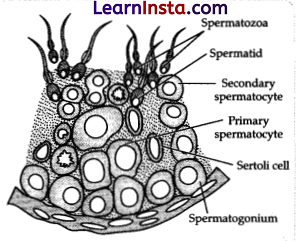
(b) Draw a diagrammatic sectional view of a seminiferous tubule (enlarged) in humans and label its parts.
Answer:
(a) (i) X- is testicular lobules found in testis. The testes are located outside the abdominal cavity within a pouch-like structure called ‘scrotum’.
(ii) The accessory gland Y is a seminal vesicle. It produces an alkaline secretion called seminal fluid which forms 60-70% of semen by volume.
(iii) Z is the epididymis. It stores sperm and also it secretes fluid containing the nutrients required for the maturation of spermatozoa.
(b) Diagrammatic sectional view of a seminiferous tubule (enlarged) in humans:
OR
The following figure shows a foetus within the uterus. On the basis of the given figure, answer the questions that follow:

(a) In the above figure, choose and name the correct part (A, B, C or D) that act as a temporary endocrine gland and substantiate your answer. Why is it also called the functional junction?
(b) Mention the role of B in the development of the embryo.
(c) Name the fluid surrounding the developing embryo. How is it misused for sex-determination?
Answer:
(a) Part labelled A -Placenta. It acts as an endocrine tissue as it produces several hormones like Human Chorionic Gonadotropin (hCG), Human Placental Lactogen (hPL), estrogen, progesterone, etc. It is also called the functional junction because it facilitates the supply of oxygen and nutrients to the embryo and removes carbon dioxide and excretory/waste materials produced by the embryo.
(b) The placenta is connected to the embryo through an umbilical cord which helps in the transport of substances to and from the embryo.
(c) Amniotic fluid; a foetal sex determination test is based on the chromosomal pattern of the cells in the amniotic fluid surrounding the developing embryo.
Question 32.
In the mid-twentieth century, scientists were still unsure as to whether DNA or protein was the genetic material of the cell. It was known that some viruses consisted solely of DNA and a protein coat and could transfer their genetic material into hosts. In 1952, Alfred Hershey and Martha Chase conducted a series of experiments.
(a) State the reasons for which Hershey and Chase carried out their experiments.
(b) Answer the following questions based on the experiments of Hershey and Chase:
(i) Name the different radioactive isotopes they used, and explain how they used them.
(ii) Why did they need to agitate and spin their culture?
(iii) Write their observations they arrived at.
Answer:
(a) Alfred Hershey and Martha Chase carried out their experiments to prove that DNA is the genetic material and not the protein.
(b) (i) They used radioactive phosphorus (32P) and radioactive sulphur (35S). They grew some viruses on a medium that contained radioactive phosphorus and some others on a medium that contained radioactive sulphur. Viruses grown in the presence of radioactive phosphorus contained radioactive DNA but not radioactive protein because DNA contains phosphorus but protein does not. Similarly, viruses grown on radioactive sulphur contained radioactive protein but not radioactive DNA because DNA does not contain sulphur.
(ii) Blender: To separate the viral protein coats that are still attached to the surface of bacteria.
Centrifuge: To separate lighter supernatant (containing viral protein coats) from the denser residue (containing bacteria).
(iii) Observations:
1. Bacteria that were infected with viruses having radioactive DNA were found to contain radioactive DNA.
2. Bacteria that were infected with viruses having radioactive protein coat were not found to contain radioactivity.
OR
(a) Study the table given below and identify (i), (ii), (iii) and (iv)
| Amino acid | Phe | Val |
| DNA code in gene | AAA | CAC |
| Codon in mRNA | (i) | (ii) |
| Anticodon in tRNA | (iii) | (iv) |
Answer:
| Amino acid | Phe | Val |
| DNA code in gene | AAA | CAC |
| Codon in mRNA | (i) UUU | (ii) GUG |
| Anticodon in tRNA | (iii) AAA | (iv) CAC |
(b) A polypeptide consists of 14 different amino adds.
(i) How many base pairs must be there in the processed mRNA that codes for this polypeptide?
(ii) How many different types of tRNA are needed for the synthesis of this polypeptide?
Answer:
(i) A polypeptide containing 14 different amino add = 14 × 3 = 42 base pairs.
(ii) 14 different types of RNA are needed for the synthesis of polypeptide.
(c) Write the contributions of the following scientists in deciphering the genetic code.
George Gamow; Hargobind Khorana; Marshall Nirenberg; Severo Ochoa.
Answer:
(c) George Gamow: He suggested that in order to code for all the 20 amino adds, the code should be made up of three nudeotides. This is because a permutation combination of 4³ (4 × 4 × 4) would generate 64 codons; generating many more codons than required. So, the codon was proposed to be a triplet.
HarGobind Khorana: He developed a chemical method to synthesise RNA molecules with defined combinations of bases (homopolymers and co-polymers).
Marshall Nirenberg: He developed a cell-free system for protein synthesis which helped the code to be deciphered.
Severo Ochoa: He discovered an enzyme (polynucleotide phosphorylase), which helped in the synthesis of RNA with defined sequences in a template-independent manner (enzymatic synthesis of RNA).
Question 33.
(a) How does a Human Immunodefidency Virus (HTV) replicate in a host?
(b) How does an HIV-infected patient lose immunity?
(c) List any two symptoms of this disease.
Answer:
(a) The HIV replicates in the host by a process of reverse transcription. In this process, the viral RNA replicates to form viral DNA with the help of the enzyme reverse transcriptase. This viral DNA then gets incorporated into the host cell’s DNA which directs the infected cell to produce virus particles.
(b) The HIV infected patients lose immunity because of loss of T-lymphocytes. The HIV enters into helper T-lymphocytes and produce progeny viruses which are released into the blood and attack other helper T-lymphocytes. This leads to the progressive decrease in number of T-lymphocytes which results in the loss of immunity as a result of which the patient is unable to protect himself from any type of infection.
(c) The common symptoms of HIV patients are
fever, diarrhoea, susceptibility to other diseases and infections.
OR
(a) Differentiate between the roles of B-lymphocytes and T-lymphocytes in generating immune responses.
(b) Explain the mechanism of action of T cells to antigens.
Answer:
(a) B-lymphocytes: Produce antibodies T-lymphocytes: Help B-lymphocytes to produce antibodies/kills the pathogen directly (Killer T-cells)
(b) Mechanism of action of T cells to antigens: T cells provide cell mediated immunity recognise specific antigens. The T lymphocyte divides rapidly/differentiate to form a done of T cells of four types:
(i) Killer cells/CT cells: Destroy infected cells having the foreign antigen attached to their surface.
(ii) Memory T cells: Are sensitised by antigens and retain their sensitization for the future/remember the nature of antigen for future (secondary) response.
(iii) Suppressor T cells: Inhibits immune response by releasing cytokines that suppress activity of other T and B cells.
(iv) Helper T cells: Secrete substances that enhance or activate immune response/stimulate antibody production of B-cells.