Students can access the CBSE Sample Papers for Class 10 AI with Solutions and marking scheme Set 7 will help students in understanding the difficulty level of the exam.
CBSE Sample Papers for Class 10 AI Set 7 with Solutions
General Instructions
- Please read the instructions carefully.
- This Question Paper consists of 21 questions in two sections: Section A & Section B.
- Section A has Objective type questions whereas Section B contains Subjective type questions.
- Out of the given (5+16)=21 questions, a candidate has to answer (5+10)=15 questions in the allotted (maximum) time of 2 hours.
- All questions of a particular section must be attempted in the correct order.
- Section A: Objective Type Questions (24 Marks)
- This section has 5 questions.
- There is no negative marking.
- Do as per the instructions given.
- Marks allotted are mentioned against each question/part.
- Section B: Subjective Type Questions (26 Marks)
- This section has 16 questions.
- A candidate has to do 10 questions.
- Do as per the instructions given.
- Marks allotted are mentioned against each question/part.
Section A
Objective Type Questions
Question 1.
Answer any 4 out of the given 6 questions on Employability Skills. (4×1=4)
(i) In the communication cycle, who initiates the process?
(a) Channel
(b) Receiver
(c) Sender
(d) Time
Answer:
(c) Sender
(ii) Which of the following is a valid file extension for Notepad file?
(a) .jpg
(b) .doc
(c) .text
(d) .txt
Answer:
(d) .txt

(iii) Riya is preparing for her exams and finds herself constantly stressed due to long study hours and pressure to perform. Her teacher suggests trying yoga to manage her stress effectively. Which of the following statements is most appropriate about yoga and stress management?
(a) Yoga is an effective technique for managing stress.
(b) Yoga combines physical postures, breathing exercises, and meditation to reduce stress levels.
(c) Both (a) and (b) are correct.
(d) Neither (a) nor (b) is correct.
Answer:
(c) Both (a) and (b) are correct.
(iv) Which of the following strategies is most effective for improving time management skills?
(a) Working on multiple tasks simultaneously to save time.
(b) Procrastinating tasks until the last minute for increased focus.
(c) Prioritizing tasks based on their importance and deadlines.
(d) Ignoring breaks to maximize continuous work periods.
Answer:
(c) Prioritizing tasks based on their importance and deadlines.
(v) Choose the option which defines sustainable development.
(a) Taking care of future generations
(b) Taking care of only ourselves
(c) Taking care of ourselves and the future generations
(d) Well-being of all
Answer:
(c) Taking care of ourselves and the future generations
(vi) Assertion (A) With the growth of a business, entrepreneurs look for more people to help them.
Reason (R) They buy more material, and also hire more people to work for them.
(a) Both A and R are correct and R is the correct explanation of A.
(b) Both A and R are correct but R is not the correct explanation of A.
(c) A is correct but R is not correct.
(d) A is not correct but R is correct.
Answer:
(a) Both A and R are correct and R is the correct explanation of A.
Question 2.
Answer any 5 out of the given 6 questions. (5×1=5)
(i) ………. is an NLP tool to express an opinion, whether the underlying sentiment is positive, negative, or neutral.
(a) Text Classification
(b) Machine Translation
(c) Sentiment Analysis
(d) Automatic Text Summarization
Answer:
(c) Sentiment Analysis
Note
Understand the unique role of each NLP tool. Sentiment Analysis is used to detect opinions or emotions in text, while tools like Text Classification group text into categories. Confusing these can lead to incorrect answers in AI-based applications.
(ii) Give two examples of Supervised Learning models.
(a) Classification and Regression
(b) Clustering and Dimensionality Reduction
(c) Rule Based and Learning Based
(d) Classification and Clustering
Answer:
(a) Classification and Regression
(iii) A retail company uses a machine learning algorithm to group similar customer purchases to improve product recommendations.
Which type of algorithm is used?
(a) Supervised Learning
(b) Unsupervised Learning
(c) Reinforcement Learning
(d) Neural Networks
Answer:
(b) Unsupervised Learning
(iv) What do frameworks provide in the context of problem-solving?
(a) Random solutions
(b) Step-by-step guidance
(c) Legal advice
(d) Ethical justifications
Answer:
(b) Step-by-step guidance
(v) Statement 1 Clustering is a machine learning technique, which groups the unlabeled dataset.
Statement 2 It is helpful for predicting numerical values based on different data points, such as sales revenue projections for a given business.
(a) Both Statement 1 and Statement 2 are correct
(b) Both Statement 1 and Statement 2 are incorrect
(c) Statement 1 is correct but Statement 2 is incorrect
(d) Statement 2 is correct but Statement 1 is incorrect
Answer:
(c) Statement 1 is correct but Statement 2 is incorrect
(vi) Assertion (A) The Convolution Layer in a Convolutional Neural Network (CNN) assigns importance to various features or objects in the image.
Reason (R) The main role of the Convolution Layer is to detect patterns such as edges, textures, or shapes using filters.
(a) Both A and R are true, and R is the correct explanation of A
(b) Both A and R are true, but R is not the correct explanation of A
(c) A is true, but R is false
(d) A is false, but R is true
Answer:
(a) Both A and R are true, and R is the correct explanation of A.
Question 3.
Answer any 5 out of the given 6 questions. (5×1=5)
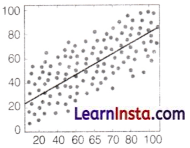
(i) Observe the image showing a line best fitting the given data points.
Identify the type of supervised learning model shown:
Answer:
Linear Regression, a line fitting the data points indicates a Linear Regression model, which predicts continuous values.
(ii) Which of the following is the correct sequence of stages in the AI Project Cycle?
(a) Problem Scoping → Data Exploration → Modeling → Evaluation
(b) Data Exploration → Problem Scoping → Modeling → Evaluation
(c) Problem Scoping → Modeling → Data Exploration → Evaluation
(d) Evaluation →Modeling → Data Exploration → Problem Scoping
Answer:
(a) Problem Scoping →Data Exploration →Modeling → Evaluation
(iii) An AI agent playing a game and learning from its rewards and penalties is an example of:
(a) Supervised Learning
(b) Unsupervised Learning
(c) Reinforcement Learning
(d) Evolutionary Learning
Answer:
(c) Reinforcement Learning
(iv) In a spam email detection system, out of 1000 emails received, 300 are spam. The system correctly identifies 240 spam emails as spam, but it also marks 60 legitimate emails as spam. What is the precision of the system?
(a) 80%
(b) 70%
(c) 75%
(d) 90%
Answer:
(a) 80%
(v) Which of the following tasks is commonly performed using Natural Language Processing (NLP)?
(a) Image classification
(b) Speech recognition
(c) Text summarization
(d) Object detection
Answer:
(c) Text summarization
(vi) Which of the following is a primary task of computer vision in artificial intelligence?
(a) Speech recognition
(b) Image classification
(c) Machine translation
(d) Text-to-speech synthesis
Answer:
(b) Image classification
Question 4.
Answer any 5 out of the given 6 questions. (5×1=5)
(i) How is the relationship between model performance and accuracy described?
(a) Inversely proportional
(b) Not related
(c) Directly proportional
(d) Randomly fluctuating
Answer:
(c) Directly proportional
(ii) Artificial Intelligence (AI) is a branch of computer science that aims to build systems capable of performing tasks that typically require human intelligence.
Which of the following is NOT a characteristic of Artificial Intelligence (AI)?
(a) Ability to learn from experience
(b) Ability to perform tasks without human intervention
(c) Ability to feel emotions like humans
(d) Ability to recognize patterns
Answer:
(c) Ability to feel emotions like humans
A Mistake Alert
Many students mistakenly think AI can feel emotions due to lifelike robots or chatbots. In reality, AI can simulate emotional responses, but does not possess real emotions or consciousness. Misunderstanding this leads to conceptual errors in ethics and capabilities of AI.
(iii) Which of the following statements is NOT true about supervised learning?
(a) Requires labeled data for training.
(b) Used for classification and regression tasks.
(c) Can be less efficient for large datasets.
(d) Often used in image recognition applications.
Answer:
(c) Can be less efficient for large datasets.
(iv) Which of the following is NOT a commonly used metric to evaluate the performance of a classification model?
(a) Accuracy
(b) Precision
(c) Mean Squared Error
(d) Recall
Answer:
(c) Mean Squared Error
(v) Statement 1 Unsupervised learning helps in identifying patterns and relationships within unlabeled data.
Statement 2 Unsupervised learning is used to train an AI agent using rewards and penalties.
(a) Both Statement 1 and Statement 2 are correct
(b) Both Statement 1 and Statement 2 are incorrect
(c) Statement 1 is correct but Statement 2 is incorrect
(d) Statement 2 is correct but Statement 1 is incorrect
Answer:
(c) Statement 1 is correct but Statement 2 is incorrect
(vi) Observe the image below and identify which of the following represents an example of Artificial Intelligence in daily life?

(a) Using a calculator to perform arithmetic
(b) Writing notes with a pen
(c) Voice assistant like Alexa or Siri
(d) Reading a book
Answer:
(c) Voice assistants like Alexa or Siri.
Question 5.
Answer any 5 out of the given 6 questions. (5×1=5)
(i) In machine learning, what is the main purpose of dividing the data into training and testing sets?
(a) To increase the size of the dataset
(b) To check how well the model performs on new, unseen data
(c) To make the model run faster
(d) To remove errors from the data
Answer:
(b) To check how well the model performs on new, unseen data
(ii) Which of the following is the primary goal of computer vision?
(a) To enable computers to understand and interpret visual information from images or videos
(b) To improve computer hardware performance
(c) To create video games with better graphics
(d) To store large amounts of data efficiently
Answer:
(a) To enable computers to understand and interpret visual information from images or videos
(iii) What is the process of breaking down a sentence into smaller parts like words or phrases called in Natural Language Processing (NLP)?
Answer:
Tokenization
(iv) The goal when evaluating an AI model is to:
(a) Maximize error and minimize accuracy
(b) Minimize error and maximize accuracy
(c) Focus solely on the number of data points used
(d) Prioritize the complexity of the model
Answer:
(b) Minimize error and maximize accuracy
(v) Statement 1 Logical-mathematical intelligence helps in solving puzzles and mathematical problems.
Statement 2 Logical-mathematical intelligence involves using language effectively.
(a) Both Statement 1 and Statement 2 are correct
(b) Both Statement 1 and Statement 2 are incorrect
(c) Statement 1 is correct but Statement 2 is incorrect
(d) Statement 2 is correct but Statement 1 is incorrect
Answer:
(c) Statement 1 is correct but Statement 2 is incorrect
(vi) Which of the following is used for finding the frequency of words in some given text sample?
(a) Stemming
(b) Lemmatisation
(c) Bag of words
(d) None of these
Answer:
(c) Bag of words
Section B
Subjective Type Questions
Answer any 3 out of the given 5 questions on Employability skills. Answer each question in 20-30 words. (3×2=6)
Question 6.
What deficit does stress management address and in what way in our lives?
Answer:
Stress management addresses the gap in mental and emotional well-being by offering techniques to cope with stress. Methods such as mindfulness, exercise, and relaxation techniques improve emotional resilience, reduce anxiety, and promote overall mental health, leading to a more balanced life.
Question 7.
Rohit, a recent graduate, struggles with effective oral communication during team meetings at his new job in an Indian corporate environment. What are three key factors that can help Rohit improve his oral communication skills in this context?
Answer:
Rohit can improve his oral communication by practicing active listening, seeking feedback, and participating in public speaking workshops. Additionally, understanding cultural nuances and incorporating clear, concise language can enhance his communication effectiveness within the Indian corporate setting.
Question 8.
What are the key benefits of agricultural entrepreneurship for rural communities?
Answer:
Agricultural entrepreneurship boosts rural economies by creating jobs, increasing incomes, and promoting sustainable farming practices. It also enhances food security, encourages innovation in farming techniques, and strengthens local supply chains, fostering overall community development and resilience.
Question 9.
How do Sustainable Development Goals (SDGs) 6 (Clean Water and Sanitation) and 9 (Industry, Innovation, and Infrastructure) interrelate?
Answer:
SDG 6 ensures availability and sustainable management of water and sanitation, which is fundamental for health, productivity, and ecosystems. SDG 9 focuses on building resilient infrastructure and promoting inclusive and sustainable industrialization.
Together, they support each other by ensuring that infrastructure development considers water efficiency and sanitation needs, promoting holistic sustainable development.
Question 10.
What are temporary files and what purpose do they serve?
Answer:
Temporary files are created by operating systems and software applications to store intermediate data. They help in freeing up memory, preventing data loss during crashes, and enhancing performance by storing temporary information needed for ongoing processes or tasks.
Answer any 4 out of the given 6 questions in 20-30 words each. (4×2=8)
Question 11.
What is Natural Language Processing (NLP), and why is tokenization important in NLP?
Answer:
NLP is a field of computer science that helps machines understand human language. Tokenization breaks text into smaller parts like words, enabling easier analysis and processing of language data.
Question 12.
Suppose you are building a spam email filter. Describe what False Positives and False Negatives mean in this context.
Answer:
False Positives are legitimate emails wrongly marked as spam. False Negatives are spam emails that the filter fails to detect, letting them reach the inbox, causing unwanted messages.
Question 13.
Describe the principle of privacy in AI and its ethical implications.
Answer:
Privacy in AI involves safeguarding personal data and respecting individuals’ right to control their information. Ethical implications include protecting users from data breaches, unauthorized surveillance, and ensuring that AI systems do not violate privacy laws or personal boundaries.
Question 14.
Why is labeled data important for machine learning, but not always necessary for artificial intelligence?
Answer:
Machine learning relies on labeled data for training models to recognize patterns, whereas artificial intelligence can use predefined rules and logic to perform tasks without always needing labeled data.
Question 15.
How Computer vision is helping in medical imaging?
Answer:
Computer Vision helps in medical imaging by analyzing X-rays, MRIs, and CT scans to detect diseases like tumors or fractures quickly and accurately, supporting faster and better diagnosis.
Question 16.
Raghav uses Snapchat daily and enjoys personalized show suggestions on Netflix. He wonders how these apps understand his preferences so well. Define Machine Learning. Also, mention any two applications of Machine Learning that are used in daily life.
Answer:
Machine Learning is a subset of Artificial Intelligence which enables machines to improve at tasks with experience (data).
Applications of Machine Learning
- The intention of Machine Learning is to enable machines to learn by themselves using the provided data and make accurate Predictions/ Decisions.
- Machine Learning is used in Snapchat Filters, NETFLIX recommendation system.
Answer any 3 out of the given 5 questions in 50-80 words each. (3×4=12)
Question 17.
An AI-based system was designed to detect fraudulent bank transactions. It was tested on a dataset of 500 transactions, and the resulting confusion matrix is given below:
| Confusion Matrix | Reality: Fraud | Reality: Not Fraud |
| Predicted Fraud | 80 | 40 |
| Predicted Not Fraud | 30 | 350 |
(a) How many total cases are True Positives in the above scenario?
(b) Calculate the Precision, Recall, and F1 Score for fraud detection.
Answer:
(a) True Positives (TP):
These are the cases where the system correctly predicted fraud,
i.e., Predicted Fraud & Reality Fraud = 80
(b) Precision =TP /(TP+FP)
= 80 /(80+40)=80 / 120
= 0.6667 (or 66.67%)
Recall (also called Sensitivity) =TP/(TP+FN)
= 80 /(80+30)=80 / 110
= 0.7273(or 72.73 %)
F1 Score = 2 *(Precision\Recall ) /(Precision+ Recall)
= 2 *(0.6667 * 0.7273)/(0.6667+0.7273)
= 2 * 0.4848 / 1.394
≈ 0.6957 (or 69.57 % )
Question 18.
Why is exploring teachable and experimental machine tools useful in learning AI?
Answer:
Using platforms like Teachable Machine or Google’s AI experiments offers hands-on experience with supervised and unsupervised learning. These interactive tools make abstract concepts more relatable by allowing learners to train and test models visually.
They help students grasp how inputs lead to outputs and improve their understanding of AI functionality. These resources enrich sessions by adding a practical layer to theoretical knowledge, fostering deeper engagement and comprehension of machine learning processes.
Question 19.
Following is the corpus:
Document 1 “AI changes industries. It uses algorithms.”
Document 2 “AI aids healthcare. It diagnoses diseases.”
Perform the following functions on the above corpus.
(a) Sentence segmentation
(b) Tokenization
(c) Stop word removal
Answer:
(a) Sentence Segmentation:
Document 1
- Sentence 1: “AI changes industries.”
- Sentence 2: “It uses algorithms.”
Document 2
- Sentence 1: “AI aids healthcare.”
- Sentence 2: “It diagnoses diseases.”
(b) Tokenization:
Document 1
- Sentence 1: [‘AI’, ‘changes’, ‘industries’, ‘.’]
- Sentence 2: [‘It’, ‘uses’, ‘algorithms’, ‘.’]
Question 18.
Why is exploring teachable and experimental machine tools useful in learning AI?
Answer:
Using platforms like Teachable Machine or Google’s AI experiments offers hands-on experience with supervised and unsupervised learning. These interactive tools make abstract concepts more relatable by allowing learners to train and test models visually.
They help students grasp how inputs lead to outputs and improve their understanding of AI functionality. These resources enrich sessions by adding a practical layer to theoretical knowledge, fostering deeper engagement and comprehension of machine learning processes.
Question 19.
Following is the corpus:
Document 1 “AI changes industries. It uses algorithms.”
Document 2 “AI aids healthcare. It diagnoses diseases.”
Perform the following functions on the above corpus.
(a) Sentence segmentation
(b) Tokenization
(c) Stop word removal
Answer:
(a) Sentence Segmentation:
Document 1
- Sentence 1: “AI changes industries.”
- Sentence 2: “It uses algorithms.”
Document 2
- Sentence 1: “AI aids healthcare.”
- Sentence 2: “It diagnoses diseases.”
(b) Tokenization:
Document 1
- Sentence 1: [‘AI’, ‘changes’, ‘industries’, ‘.’]
- Sentence 2: [‘It’, ‘uses’, ‘algorithms’, ‘.’]
Document 2
- Sentence 1: [’AI’, ‘aids’, ‘healthcare’, ‘]
- Sentence 2: [‘It’, ‘diagnoses’, ‘diseases, ‘.‘]
(c) Stop Word Removal:
Document 1
- Sentence 1: [AI’, ‘changes, ‘industries]
- Sentence 2: [uses’, ‘algorithms’s]
Document 2
- Sentence 1: [‘AI’, ‘aids’, ‘healthcare]
- Sentence 2: [‘diagnoses’, ‘diseases]
Question 20.
Observe the given image and answer the questions that follow.

(a) What concept related to ethics is shown in this AI-medical context?
(b) How do such scenarios help students understand the importance of ethics in AI?
Answer:
(a) The concept shown is bioethics, which deals with ethical concerns in AI used in healthcare, such as patient privacy, data security, and informed consent.
(b) Such real-life AI scenarios help students understand ethical dilemmas by examining issues like fairness, safety, and accountability, making them aware of the need to protect human dignity and prevent harm through responsible AI use.
Question 21.
A machine learning model was evaluated using a confusion matrix. The result were as follows
| Predicted Positive |
Predicted Negative |
|
| Actual Positive | 50 | 10 |
| Actual Negative | 5 | 35 |
(a) Calculate Accuracy and Recall.
(b) What do you infer from the results?
Answer:
From given confusion matrix, we can calculate the following values:
True Positives (TP): 50
False Positives (IP): 5
False Negatives (FN): 10
True Negatives (TN): 35
(a) Accuracy = (True Positives + True Negatives) I (Total Samples)
TotalSamples=TP+TN +FP+FN=50+35+5+ 10= 100
Accuracy = (50 + 35) / 100 = 85/100 = 0.85 or 85%
Recall = True Positives / (True Positives + False Negatives)
Recall = 50/(50+ 10) = 50/60 0.833 or 83.3%
(b) High Accuracy The model performs well overall, correctly predicting 85% of the samples.
High Recall The model is quite effective at identifying positive cases, catching 83.3% of them. This suggests that it’s good at detecting the condition or class it’s supposed to identifc