Students can use Poorvi Book Class 8 Solutions Unit 2 Values and Dispositions Chapter 4 A Tale of Valour: Major Somnath Sharma and the Battle of Badgam Questions and Answers as a quick reference guide.
A Tale of Valour: Major Somnath Sharma and the Battle of Badgam Class 8 Questions and Answers
A Tale of Valour: Major Somnath Sharma and the Battle of Badgam Class 8 Question Answer
NCERT Class 8 English Poorvi Chapter 4 A Tale of Valour: Major Somnath Sharma and the Battle of Badgam Question Answer
A Tale of Valour: Major Somnath Sharma and the Battle of Badgam Question Answer – Let us do these activities before we read. (Page 49)
I. Work in pairs. Share your answers with your classmates and teacher.
Question 1.
What do you think about the Republic Day Parade on 26 January?
Answer:
Republic Day Parade is a grand and patriotic event that showcases India’s culture, unity, and military strength. Republic Day is celebrated every year with great enthusiasm. The parade begins at the forecourt of Rashtrapati Bhavan, passes through Kartavya Path, India Gate and concludes at the Red Fort. The President of India unfurls the National Flag—the Tricolour—to mark the occasion.
Question 2.
What are the highlights of this parade?
Answer:
The highlights include military marches, cultural tableaux from different states, performances by school children, and an air show by the Indian Air Force. The event is attended by the Prime Minister, the Chiefs of the Armed Forces, the Council of Ministers, and several prominent national and international dignitaries.
Question 3.
What bravery awards are given on this day, and who receives them?
Answer:
Bravery awards like the Gallantry Awards (Param Vir Chakra, Ashok Chakra, etc.) are given to soldiers and civilians who show exceptional courage.

II. Work in groups of four and discuss.
Question 1.
What qualities do you think a soldier should have?
Answer:
A soldier should have courage, discipline, loyalty, determination, and a strong sense of duty.
Question 2.
If you had to share a message with a soldier, what would it be?

Answer:
“Thank you for your bravery and sacrifice. We are proud of you and forever grateful for your service to our nation.”
A Tale of Valour: Major Somnath Sharma and the Battle of Badgam Class 8 Question Answer – Let us discuss (Page 59)
I. Arrange the following events in chronological order. The first and the last events have been marked for you. Share your answers with your classmates and teacher.
1. Major Somnath Sharma was born in 1923 in Kangra, Himachal Pradesh. (1)
2. Even after losing Major Somnath Sharma, the soldiers fought bravely to save Srinagar for India.
3. The D Company, under the command of Major Somnath Sharma, was flown into Srinagar.
4. Major Somnath Sharma underwent training at the Royal Military College, Sandhurst.
5. Major Somnath Sharma requested air strikes to combat the enemy at Badgam.
6. Major Somnath Sharma was commissioned into the 19th Hyderabad Regiment in 1942.
7. Major Somnath Sharma was killed immediately after a mortar shell hit him.
8. Major Somnath Sharma was the fist recipient of the Param Vir Chakra. (8)
Answer:
1. Major Somnath Sharma was born in 1923 in Kangra, Himachal Pradesh. [1]
2. Even after losing Major Somnath Sharma, the soldiers fought bravely to save Srinagar for India. [7]
3. The D Company, under the command of Major Somnath Sharma, was flown into Srinagar. [4]
4. Major Somnath Sharma underwent training at the Royal Military College, Sandhurst. [2]
5. Major Somnath Sharma requested air strikes to combat the enemy at Badgam. [5]
6. Major Somnath Sharma was commissioned into the 19th Hyderabad Regiment in 1942. [3]
7. Major Somnath Sharma was killed immediately after a mortar shell hit him. [6]
8. Major Somnath Sharma was the first recipient of the Param Vir Chakra. [8]
Class 8 English A Tale of Valour: Major Somnath Sharma and the Battle of Badgam Question Answer – Let us Think and reflect (Pages 59-61)
I. Read the given extracts and answer the questions that follow.
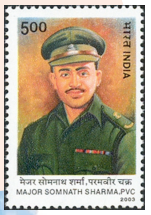
1. Vastly outnumbered and facing devastating fire, Major Somnath Sharma and his men stood resolute. The air was thick with the sound ofgunfire and the cries of battle, but Major Somnath Sharma’s voice cut through the chaos, urging his men to fight with tenacity and valour.
Despite heavy casualties and his own injuries, Major Somnath Sharma displayed unparalleled bravery. He moved fearlessly through the bat-tlefield, directing fire, filling magazines for his gunners, and encouraging his men to hold their ground.
(i) What can be inferred about the conditions from the line: ‘The air was thick with gunfire…’
A. The gunshots had stopped for a while.
B. There was intense fighting on the battlefield.
C. The invaders were retreating from the fight.
D. The Indian soldiers had achieved victory.
Answer:
B. There was intense fighting on the battlefield.
(ii) Complete the sentence with a suitable reason.
Despite heavy casualties, Major Somnath Sharma continued to lead his men because _______
Answer:
Despite heavy casualties, Major Somnath Sharma continued to lead his men because he was determined to protect his country and inspire his soldiers with courage and bravery.
(iii) Select the correct option for both Assertion (A) and Reason (R) given below:
(A): Major Somnath Sharma moved fear-lessly through the battlefield, even though he was injured
(R): He believed his courage was important to motivate the soldiers.
A. Both (A) and (R) are true, and (R) is the correct explanation of (A).
B. Both (A) and (R) are true, but (R) is not the correct explanation of (A).
C. (A) is true, but (R) is false.
D. (A) is false, but (R) is true.
Answer:
A. Both (A) and (R) are true, and (R) is the correct explanation of (A).
(iv) Fill in the blank with the correct word from those given in the brackets: Major Somnath Sharma was filling magazines, and encouraging his men to hold
their ground despite (injuries/worry)
Answer:
Major Somnath Sharma was filling magazines, and encouraging his men to hold their ground despite injuries.
2. Born on 31 January 1923, in the picturesque town ofDadh in Kangra, Himachal Pradesh, Somnath Sharma belonged to a family with a rich military legacy. His father, Major General Amar Nath Sharma, had served the nation with distinction, and young Somnath was deeply inspired by the valorous tales of the Mahabharata, imparted to him by his grandfather. ”
(i) What can be inferred about Somnath Sharma’s early influences on his. career?
A. He was primarily influenced by his father’s achievements in the military.
B. His inspiration came solely from the tales of the Mahabharata.
C. His family and heritage inspired his bravery and sense of duty.
D. He decided to join the military out of necessity rather than passion.
Answer:
C. His family and heritage inspired his bravery and sense of duty.
(ii) Identify whether the following statement is true or false:
Somnath Sharma belonged to a wealthy family.
Answer:
True: Major Somnath Sharma’s father was an ex-serviceman who retired as a Major General. He received his education at Sherwood College, Nainital, and underwent military training at the Royal Military College, Sandhurst.
(iii) What does the phrase ‘served the nation with distinction’ tell us about Major General Amar Nath Sharma? (He performed his duties with exceptional dedication, honour, and excellence./He was highly respected for his contributions to the country.)
Answer:
He performed his duties with exceptional dedication, honour, and excellence.
(iv) Replace the underlined phrase with a word from the extract that has a similar meaning.
My family and I visited a popular hill station and stayed in an old but visually charming house surrounded by trees.
Answer:
The underlined phrase “visually charming” can be replaced with the word “picturesque” from the extract.
II. Answer the following questions.
Question 1.
‘Major Somnath’s legacy of courage and devotion to the nation remains forever alive, forever alive…’ What is the significance of the repetition in this line?
Answer:
The repetition of the line “forever alive, forever alive…” shows how important and unforgettable Major Somnath Sharma’s braveiy and sacrifice are. It reminds us that his courage and love for the country will always be remembered. The words create a strong emotional impact and .help us understand that his legacy will never fade, even with time.
Question 2.
Why do you think Major Somnath’s leadership was critical during the Battle of Badgam?
Answer:
Major Somnath Sharma’s leadership was critical during the Battle of Badgam because he inspired his men to fight bravely even when they were heavily outnumbered. He stayed calm under pressure and made quick decisions, like requesting air strikes. Despite being injured, he helped his soldiers by filling magazines and encouraging them. His bravery and leadership delayed the enemy, giving time for reinforcements to arrive. This helped save Srinagar and protect Kashmir.
Question 3.
What were Major Somnath’s last words? What do they reflect about his sense of duty?
Answer:
Major Somnath Sharma’s last words were:
“The enemy is only 50 yards from us. We are heavily outnumbered. We are under devastating fire. I shall not withdraw an inch but will fight to the last man and the last round. ”
These words reflect his strong sense of duty, bravery, and commitment to protect his country at any cost. Even in the face of death, he chose to fight rather than retreat, showing his deep loyalty and courage.
Question 4.
What might have been the outcome of the Battle of Badgam if Major Somnath and his company had not held their ground?
Answer:
If Major Somnath Sharma and his company had not held their ground during the Battle of Badgam, the enemy could have captured the Srinagar airport and the Kashmir Valley. This would have given them control over a very important area and been a major loss for India. By holding their position, Major Somnath’s company gave enough time for reinforcements to arrive and protect the region. Without their brave stand, Kashmir might have fallen into enemy’s hands.
Question 5.
Why do you think Major Somnath’s story continues to inspire soldiers and civilians today?
Answer:
Major Somnath’s story continues to inspire soldiers and civilians today because it shows true courage, selflessness, and love for the country. Even when he was injured and outnumbered, he chose to fight bravely and lead his men. His sacrifice helped protect Kashmir and saved many lives. His strong sense of duty reminds us to stay brave and committed, no matter how hard the situation is. His actions are a powerful example of patriotism for all generations.
Question 6.
How can the values demonstrated by Major Somnath Sharma— courage, duty, and self-sacrifice— be applied in our daily lives?
Answer:
The values shown by Major Somnath Sharma—courage, duty, and selfsacrifice—can be used in our daily lives in many ways:
- Courage: We can be brave by standing up for what is right, even if we are scared or alone.
- Duty: We can take our responsibilities seriously, whether it’s studying, helping at home, or being honest.
- Self-sacrifice: We can think about others before ourselves, like sharing, helping friends, or giving up small things for a bigger good.
By following these values, we can become better people and help make our community stronger and kinder.
A Tale of Valour: Major Somnath Sharma and the Battle of Badgam Class 8 Questions and Answers – Let us learn (Pages 62-66)
I. Match the expressions from the text in Column 1 with the most suitable situations given in Column 2.
| Column 1 | Column 2 |
| 1. Fight to the last man | (i) A sports team scores a last-minute goal, giving them the lead and shaking the opponent’s confidence. |
| 2. Foil the plan | (ii) The soldiers fought valiantly until each one laid down his life for the nation. |
| 3. Deliver a blow | (iii) Soldiers stay in their position and fight back, even though the enemy is stronger. |
| 4. Hold their ground | (iv) A spy disrupts the enemy’s efforts to invade a country by intercepting their communications. |
Answer:
| Column 1 | Column 2 |
| 1. Fight to the last man | (ii) The soldiers fought valiantly until each one laid down his life for the nation. |
| 2. Foil the plan | (iv) A spy disrupts the ene-my’s efforts to invade a country by intercepting their communications. |
| 3. Deliver a blow | (i) A sports team scores a last-minute goal, giving them the lead and shaking the opponent’s confidence. |
| 4. Hold their ground | (iii) Soldiers stay in their position and fight back, even though the enemy is stronger. |
Now complete the following sentences using the expressions in Column 1.
A. The detective managed to ______________ by fiding the hidden evidence before the culprit could get rid of it.
B. The company’s new advertising campaign was meant to ______________ to their competitors’ sales.
C. The hikers chose to ______________ despite the heavy rain, refusing to turn back on their journey.
D. Despite being heavily outnumbered, the soldiers vowed to defend their homeland and ______________, refusing to surrender to the enemy
Answer:
A. The detective managed to foil the plan by finding the hidden evidence before the culprit could get rid of it.
B. The company’s new advertising campaign was meant to deliver a blow to their competitors’ sales.
C. The hikers chose to hold their ground despite the heavy rain, refusing to turn back on their journey.
D. Despite being heavily outnumbered, the soldiers vowed to defend their homeland and fight to the last man, refusing to surrender to the enemy forces.
II. Read the highlighted words in the following sentence from the text.
A contingent of troops posted to Jammu and Kashmir was air-lifted into Srinagar…
There are many such collective nouns used in the context of armed forces.
Match the collective nouns in Column 1 to their meanings in Column 2. You may refer to a dictionary.

| Column 1 | Column 2 |
| 1. regiment | (i) a large body of troops ready for battle, especially an infantry unit. |
| 2. squadron | (ii) a permanent unit of an army typically commanded by a lieutenant colonel/ colonel and divided into several companies. |
| 3. fleet | (iii) a small unit, typically com¬prising 12-24 aircrafts and their crews used in air force, naval, or army aviation services. |
| 4. battalion | (iv) a group of ships sailing together, engaged in the same activity, or under the same ownership. |
Answer:
| Column 1 | Column 2 |
| 1. regiment | (ii) a permanent unit of an army typically commanded by a lieutenant colonel/ colonel and divided into several companies |
| 2. squadron | (iii) a small unit, typically comprising 12-24 aircrafts and their crews used in air force, naval, or army aviation services. |
| 3. fleet | (iv) a group of ships sailing together, engaged in the same activity, or under the same ownership |
| 4. battalion | (i) a large body of troops ready for battle, especially an infantry unit |
Now, fill in the blanks suitably with words from Column-1 in the table.
A. The commanding officer addressed the entire ________ of soldiers during the morning assembly.
B. The admiral ordered the entire ________ to set sail for battle.
C. The ________ of infantry advanced slowly through the dense forest.
D. A ________ of fihter jets was sent to intercept the enemy planes.
Answer:
A. The commanding officer addressed the entire regiment of soldiers during the morning assembly.
B. The admiral ordered the entire fleet to set sail for battle.
C. The battalion of infantry advanced slowly through the dense forest.
D. A squadron of fighter jets was sent to intercept the enemy planes.
III. Read the following words from the text and fill in the blanks with the correct words by taking clues from the meanings given below in the box.
(overwhelm overthrow overrun)
Meanings
1. To take and seize control: ____________
2. To invade or occupy an area in large numbers: ____________
3. To flod or overpower someone or something emotionally: ____________
Answer:
1. To take and seize control: overthrow
2. To invade or occupy an area in large numbers: overrun
3. To flood or overpower someone or something emotionally: overwhelm
Now, create a list of at least five other verbs that begin with ‘over’ and frame sentences of your own.
Answer:
Five other verbs that begin with ‘over’ with their sentences are:
1. Overestimate: Don’t overestimate your abilities before attempting the final exam.
2. Overcook: She accidentally overcooked the pasta, making it too soft.
3. Overwork: If you overwork yourself, you’ll fall sick.
4. Overreact: There’s no need to overreact; it was just a small mistake.
5. Overlook: Please don’t overlook the details in the project report.
IV. In the following pairs of words, ‘c’ is used for nouns, while ‘s’ is used for verbs.
- advice (noun) and advise (verb)
- practice (noun) and practise (verb)
- device (noun) and devise (verb)
- council (noun) and counsel (verb)
Now, fill in the blanks correctly with the words given in the brackets.
1. The teacher’s (i) ____________ is always helpful, and she continues to (ii) ____________ students on their career choices. (advice/advise)
2. The musician believes that daily (i) ____________ helps a lot, so she is always ready to (ii) ____________ her harmonium lessons. (practice/practise)
3. The scientist uses a strange (i) ____________ for experiments and plans to (ii) ____________ new methods for his analysis. (device/devise)
4. The village (i) ____________ met to discuss issues and decided to (ii) ____________ the villagers on important matters. (council/counsel)
Answer:
1. The teacher’s (i) advice is always helpful, and she continues to (ii) advise students on their career choices.
2. The musician believes that daily (i) practice helps a lot, so she is always ready to (ii) practise her harmonium lessons.
3. The scientist uses a strange (i) device for experiments and plans to (ii) devise new methods for his analysis.
4. The village (i) council met to discuss issues and decided to (ii) council the villagers on important matters.
V. Read the highlighted words in the following sentences from the text.
- ….ended with echoes of courage that serve as an inspiration …
- A contingent of troops posted to Jammu and Kashmir was airlifted into Srinagar…
- D. Company with 90 soldiers was the last and they were expected to return by 2:00 p.m.
- The life and sacrifice of Major Somnath Sharma embody the highest ideals of duty, honour and patriotism.
The highlighted words are either singular verbs or plural verbs. They are in agreement with the subject of the sentence. This is called Subject-Verb Agreement.
| GOLDEN GRAMMAR TIPS
Subject-Verb Agreement, refers to the grammatical rule that the verb in a sentence must match the subject in terms of number (singular or plural). Here are some key rules with examples: 1. Singular subjects take singular verbs, and plural subjects take plural verbs.
2. When two singular subjects are joined by “or” or “nor,” use a singular verb.
3. When a singular and plural subject are joined by “or” or “nor,” the verb agrees with the subject closest to it.
4. Collective nouns (team, family, group) can take singular or plural verbs depending on meaning.
5. Indefinite pronouns (everyone, someone, nobody) take singular verbs.
6. Expressions like “a number of’ take plural verbs, while “the number of’ takes singular verbs.
|
Now, fill in the blanks for the following sentences by choosing the correct verb given within brackets:
1. The bouquet of flwers __________ (is/are) beautiful.
2. Neither the teacher nor the students __________ (was/were) aware of the change in the schedule.
3. Each of the participants __________ (has/have) submitted their projects on time.
4. The data collected by the researchers __________ (shows/show) signifiant trends.
5. One of the players __________ (was/were) injured during the match.
6. Either the children or their guardian __________ (has/have) to attend the meeting.
7. A pair of shoes __________ (is/are) missing from the rack.
8. Neither of the statements __________ (is/are) true.
9. The members of the jury __________ (has deliver/have delivered) their verdict to the court.
10. Mathematics __________ (is/are) an interesting subject for many students.
Answer:
1. The bouquet of flowers is beautiful.
2. Neither the teacher nor the students were aware of the change in the schedule.
3. Each of the participants has submitted their projects on time.
4. The data collected by the researchers show significant trends.
5. One of the players was injured during the match.
6. Either the children or their guardian has to attend the meeting.
7. A pair of shoes is missing from the rack.
8. Neither of the statements is true.
9. The members of the jury have delivered their verdict to the court.
10. Mathematics is an interesting subject for many students.
VI. Read the following passage and correct the incorrect usage of verbs. One example has been done for you.
- A battalion of soldiers stand at attention as the National flag are raised.
- A battalion of soldiers stands at attention as the National flag is raised.
Each soldier salute with pride while the commander and his assistants inspects the parade. The sound of marching feet echo through the air as a group of cadets prepare for their drill. Meanwhile, a convoy of military vehicles pass by, drawing cheers from the gathered crowd.
Answer:
Each soldier salutes with pride while the commander and his assistants inspect the parade. The sound of marching feet echoes through the air as a group of cadets prepares for their drill. Meanwhile, a convoy of military vehicles passes by, drawing cheers from the gathered crowd.
A Tale of Valour: Major Somnath Sharma and the Battle of Badgam Question Answer Class 8 – Let us Listen (Page 66)
I. You will listen to a talk about the Param Vir Chakra. As you listen, complete the sentences by filling in the blanks with one or two exact words or phrases you hear. (Transcript for teacher on page 98)
Hello, everyone!
Let me tell you about the Param Vir Chakra. It is one of the most prestigious awards in India and signifis the ‘Wheel of the Ultimate Brave.’ This award is granted for ‘exemplary bravery in the presence of the enemy.’ This means that this award is given to someone who shows extraordinary courage and bravery while fihting the enemy.
The medal was instituted as a Gallantry Medal with retrospective effct from 15 August 1947 by Dr. Rajendra Prasad, the then President of India. The medal was designed by Mrs. Savitri Khanolkar, who drew inspiration from Sage Dadhichi, a Vedic rishi, who made the ultimate sacrifie by giving up his body so that the gods could create a deadly weapon called Vajra, or Thunderbolt, from his spine.
The Param Vir Chakra is cast in bronze. At its centre, on a raised circle, is the State Emblem of India. Surrounding it are four replicas of Indra’s Vajra, lined with lotus flwers. That, my dear friends, is the Param Vir Chakra, a true symbol of bravery.
Thank you
1. The Param Vir Chakra signifies the ‘Wheel of the Ultimate____________’.
2.The Param Vir Chakra is awarded to someone who shows exemplary bravery while fihting with the ____________.
3.The Param Vir Chakra was introduced as a Gallantry Medal in 1947 by the ____________.
4.The design of the Param Vir Chakra is inspired by Sage Dadhichi, who was a ____________.
5.The state emblem in the centre of the Param Vir Chakra is surrounded by the Vajra and ____________.
Answer:
1. The Param Vir Chakra signifies the “Wheel of the Ultimate Brave’.
2. The Param Vir Chakra is awarded to someone who shows exemplary bravery while fighting with the enemy.
3. The Param Vir Chakra was introduced as a Gallantry Medal in 1947 by the President of India.
4. The design of the Param Vir Chakra is inspired by Sage Dadhichi, who was a Vedic rishi.
5. The state emblem in the centre of the Param Vir Chakra is surrounded by the Vajra and lotus flowers.
Class 8 English Chapter 4 Question Answer – Let us Speak (Pages 66-67)
I. As the citizens of a nation, we all must fulfil our duty. In groups of 4-5, speak about how you propose to serve your nation.
You can choose from the themes given below:
- Saving the environment
- Health and well-being
- Helping others
- Righteous conduct
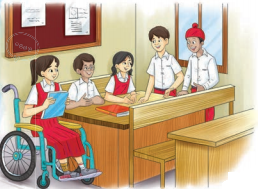
You may use the sentence prompts given below to organise what you speak about.
- I believe one of the best ways to serve the nation is by…
- A small change we can make is… and it will have a big impact because …
- If everyone contributes by… it can lead to…
- One of the biggest challenges we face is… and I propose we address it by…
- We can make a difference by working together as a team, if we…
- Serving the nation is not just about big actions; even small efforts like… matter.
Answer:
(a) A discussion in a group with the theme “Saving the Environment”:
Student 1: I believe one of the best ways to serve the nation is by spreading awareness about the importance of conserving natural resources. People act better when they understand the consequences of their actions.
Student 2: A small change we can make is reducing our use of single-use plastics, and it will have a big impact because it will decrease the amount of waste polluting our oceans and harming marine life.
Student 3: If everyone contributes by planting a tree or maintaining a small garden, it can lead to greener cities and improved air quality.
Student 4: One of the biggest challenges we face is careless littering and poor waste management, and I propose we address it by starting recycling programs in schools and communities.
Student 5: We can make a difference by working together as a team, if we organise regular clean-up drives, eco-clubs, and awareness campaigns.
Student 6: Serving the nation is not just about big actions, even small efforts like turning off lights when not in use or carrying reusable water bottles matter.
(b) A discussion in a group with the theme “Health and well-being”:
Student 1: “I believe one of the best ways to serve the nation is by focusing on health and well-being. A healthy nation is a productive nation, and when people feel good, they can contribute more to society.”
Student 2: “I agree! A small change we can make is encouraging daily physical activity, like playing outside for at least an hour. It will have a big impact because it not only improves physical health but also reduces stress and boosts mental well-being, leading to happier and more focused individuals.”
Student 3: “If everyone contributes by spreading awareness about balanced nutrition and the importance of sleep, it can lead to a significant decrease in lifestyle diseases and a healthier population overall. Imagine if every family made small, healthy food swaps!”
Student 4: “One of the biggest challenges we face is the increasing screen time among young people, which often leads to sedentary lifestyles and affects eyesight and sleep patterns. I propose we address it by organising community-wide ‘digital detox’ campaigns and creating more accessible public spaces for sports and recreation, like parks and playgrounds, to encourage outdoor activities.”
Student 5: “And we can make a difference by working together as a team, if we start by setting good examples in our own families and schools, and then spreading the message to our friends and neighbours. Even small initiatives like organising a school health fair or a community walkathon can have a ripple effect.”
Student 6: “Absolutely. Serving the nation is not just about big actions; even small efforts like choosing to walk or cycle instead of taking a vehicle, or packing a healthy lunch every day, matter. These individual choices, when multiplied by millions, contribute to a healthier and stronger India.”
(c) A sample of the discussion in a group with the theme “Helping others” can be:
Student 1: “I believe one of the best ways to serve the nation is by focusing on helping others. When we help those in need, we build a stronger, more compassionate society where everyone feels supported and valued.”
Student 2: “I completely agree. A small change we can make is volunteering a few hours each month at a local old age home or orphanage. It will have a big impact because it provides much-needed company and assistance to those who are lonely or don’t have family support, making them feel loved and not forgotten.”
Student 3: “If everyone contributes by donating unused clothes, books, or toys to charitable organisations, it can lead to ensuring that more people have access to basic necessities and educational resources. Even small things we don’t need anymore can be a huge help to someone else.”
Student 4: “One of the biggest challenges we face is the increasing isolation and lack of empathy in some communities, especially with people spending more time online. I propose we address it by organising community outreach programs and ‘kindness drives’where we actively look for opportunities to help our neighbours, like assisting an elderly person with groceries or tutoring a younger student who is struggling with studies.”
Student 5: “And we can make a difference by working together as a team, if we start by identifying needs in our immediate surroundings – our street, our apartment complex, or our school – and then pooling our resources and time to address them. Even something as simple as helping a classmate understand a difficult subject can make a difference.”
Student 6: “That’s true. Serving the nation is not just about big actions; even small efforts like offering a helping hand to a friend, sharing our lunch with someone who forgot theirs, or simply listening empathetically to someone who is sad, matter. These acts of kindness create a positive chain reaction throughout society.”
(d) A discussion in a group with the theme “Righteous Conduct”:
Student 1: I believe one of the best ways to serve the nation is by setting an example through our actions—being honest, kind, and fair in everyday life.
Student 2: A small change we can make is speaking the truth even when it’s hard, and it will have a big impact because it builds trust and respect.
Student 3: If everyone contributes by helping someone in need, it can lead to a more compassionate and united society.
Student 4: One of the biggest challenges we face is peer pressure that leads us to make wrong choices, and I propose we address it by promoting open conversations and supporting one another in doing what’s right.
Student 5: We can make a difference by working together as a team, if we stand up against bullying, cheating, or any form of injustice.
Student 6: Serving the nation is not just about big actions, even small efforts like showing respect to elders, following rules, and being kind to strangers matter.
NCERT Class 8 English Poorvi Chapter 4 Question Answer – Let us write (Pages 67 – 68)
|
GOLDEN WRITING TIPS A letter of enquiry is a formal letter written to request information about a product, service, or opportunity. |
I. Now, write a letter of enquiry. Your school wishes to organise a visit to a Memorial in your state/region. Write the letter to the incharge of that memorial requesting for information regarding available dates for visits, the duration of the tour, any entry fees, and guidelines for student groups.
- Follow the given layout.
- Use the cues given below to draft the letter.

| Body of the Letter | Prompts for Enquiry |
| Paragraph 1: State the purpose of writing |
|
| Paragraph 2: Ask for more details |
|
| Paragraph 3: Request an early response |
|
Answer:
Green Valley Public School
M.G. Road, Jaipur – 302001
28 October 2025
The Incharge
Amar Jawan Jyoti Memorial
Janpath, Jaipur – 302005
Subject: Enquiry about a School Visit to a Memorial
Dear Sir,
This is to enquire about the possibility of organising a school visit to the Amar Jawan Jyoti Memorial for the students.
Firstly, I request you to share the available dates for educational tours. Secondly, I would appreciate if you could explain the duration of the guided tour and if any student-friendly activities are included. I would also be grateful to get further details on the entry fees, if applicable, and any specific guidelines or rules for student groups.
An early reply will be greatly appreciated, as it will help us make the necessary arrangements in time. I look forward to your guidance and support in making this educational trip meaningful and memorable for the students.
Yours sincerely,
Aarti Mehra
Class 8th English Chapter 4 A Tale of Valour: Major Somnath Sharma and the Battle of Badgam Question Answer – Let us Explore (Pages 68-69)
I. Out of twenty-one FVC awardees, Major Somnath Sharma was the first recipient of the PVC, and Captain Vikram Batra was the last recipient of the PVC, the highest gallantry award.
Answer:
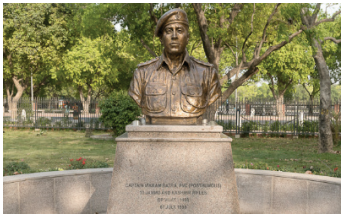
A bust of Param Vir Chakra Awardee Captain Vikram Batra at the National War Memorial in Delhi. (Source: National War Memorial)
Captain Vikram Batra, is popularly remembered as the “Shershah of Kargil”. His iconic success signal was ‘Yeh Dil Mange More’. Captain Vikram Batra, the D Company commander was tasked to capture Point 5140 on 20 June 1999, which he did with exemplary courage. After Point 5140 was captured, 13 JAK RIF was tasked to capture Point 4875. On 07 July 1999, Captain Batra led the assault from the front and engaged in a physical flight with the enemy. He killed fie enemy soldiers at point blank range and himself sustained serious injuries. Despite his injuries, his dauntless determination inspired his men to clear the enemy from a dominating position. Later, he succumbed to his injuries. His fearless determination and leadership encouraged his company men to avenge his death and finally captured Point 4875.
His inspiring leadership, dedication to duty, and steadfast love for his country continue to be an inspiration for the younger generation. He attended the call of duty with absolute disregard for his personal safety. He was awarded the Param Vir Chakra, (Posthumously).
II. Gallantry awards in India are given to military personnel and others for displaying extraordinary courage in the line of duty.
Some of the gallantry awards in India are:
- Param Vir Chakra: The highest military award in India, awarded for the most conspicuous bravery in the presence of the enemy.
- Maha Vir Chakra: The second-highest military award in India, awarded for acts of gallantry in the presence of the enemy.
- Vir Chakra: Awarded for acts of gallantry in the presence of the enemy.
Find out more about gallantry awards.
Answer:
- Ashoka Chakra: Highest peacetime military decoration, awarded for most conspicuous bravery or some act of daring or pre-eminent act of valour or self-sacrifice otherwise than in the face of the enemy.
- Kirti Chakra: Second-highest peacetime gallantry award, awarded for conspicuous gallantly in non-combat situations, often involving internal security, counterinsurgency, or rescue operations.
- Shaurya Chakra: Third-highest peacetime gallantry award, awarded for gallantry in peacetime, including acts of bravery during anti-terror operations.
III. The Indian government has been steadfast in its initiatives to boost the representation of women in the Indian Armed Forces. These women have been serving the nation selflessly and with pride. Find out the key roles of women in the Indian Army. Share the information with your classmates and teacher.
Answer:
Women in the Indian Army play a variety of important roles, both in non-combat and combat service support branches. They contribute to logistics, engineering, education, and even lead all-male contingents in parades and exercises. They serve in various branches like the Army Medical Corps, Army Dental Corps and in Corps of Army Aviation as pilots.
IV. Birsa Munda: A Saga of Courage and Sacrifice.
Answer:
Birsa Munda, a revered tribal freedom fihter, spiritual leader, and folk hero, belonged to the Munda tribe. Celebrated as a valiant warrior and a charismatic fiure, he emerged as a powerful symbol of tribal resistance against British colonial rule. Among the people of Jharkhand, he is affctionately known as Dharti Aaba—Father of the Land—and is honoured as a divine fiure for his selflss dedication to his people.

A commemorative stamp designed by Shri Sankha Samanta captures his powerful presence. It features Birsa Munda addressing his followers, with a determined expression that reflcts his unwavering vision of tribal unity, empowerment, and self-governance. This stamp serves as a lasting tribute to his pivotal role in India’s freedom struggle and his relentless commitment to protecting tribal rights
Source: https://pib.gov.in/PressReleasePage.aspx?PRID=2073652
Scan the QR Code to more information

V. Make a list of the patriotic songs in any language, including songs from your region. Share the songs with your classmates and teacher.
Answer:
Here is a list of patriotic songs of India in Hindi. You may Scan the QR Codes to listen and view a few of these patriotic songs.
1. “Vande Mataram” (Often considered the national song of India, originally in Bengali by Bankim Chandra Chattopadhyay, with various popular Hindi versions.

2. “Jana Gana Mana” (National Anthem of India, originally in Bengali by Rabindranath Tagore)

3. “Aye Mere Watan Ke Logo” (Sung by Lata Mangeshkar, iconic post-1962 war song)

4. “Sare Jahan se Achchha Hindustan hamara” by Muhammad Iqbal.
5. “Rang De Basanti” (From the film Rang De Basanti, symbolizes youthful patriotism)
6. “Ae Watan” (From the film Raazi, soulful and poignant)
7. “Bharat Humko Jaan Se Pyara Hai” (From the film Roja, celebrates the diversity of India)
8. “Sandese Aate Hain” (From the film Border, about soldiers and their longing for home)
9. “Chak De! India” (From the film Chak De! India, inspiring and about national pride in sports)
10. “Desh Mere Desh” (From the film The Legend ofBhagat Singh)