Each of our Ganita Prakash Class 7 Worksheet and Class 7 Maths Chapter 7 A Tale of Three Intersecting Lines Worksheet with Answers Pdf focuses on conceptual clarity.
Class 7 Maths Chapter 7 A Tale of Three Intersecting Lines Worksheet with Answers Pdf
A Tale of Three Intersecting Lines Class 7 Maths Worksheet
Class 7 Maths Chapter 7 Worksheet with Answers – Class 7 A Tale of Three Intersecting Lines Worksheet
Tick (✓) for the correct option
Question 1.
ABC is an isosceles triangle with AB = 5 cm and BC = 6 cm. Then the length of CA is
(a) 5.5 cm
(b) 6.5cm
(c) 11 cm
(d) 5 cm or 6 cm E
Question 2.
A ABC is an equilateral triangle with AB = 7 cm. Then the sum of the lengths of BC and CA is
(a) 7 cm
(6) 14 cm
(c) 10.5 cm
(d) Cannot be determined
Question 3.
Which of the following is not an element of ∆ACE?
(a) AC
(b) CE
(c) ∠X
(d) ∠C
Question 4.
A triangle with which of the following triplets as side lengths is not possible?
(a) 4, 6, 8
(b) 3, 5, 9
(c) 4, 4, 7
(d) 10, 20, 25
Question 5.
The lengths of the two sides of a triangle are 5 cm and 7 cm. Then the length of the third side could be
(a) 1 cm
(b) 8 cm
(c) 1.5 cm
(d) None of these
Question 6.
A triangle with which of the following triplets as side lengths is possible?
(a) 3, 7, 10
(b) 3, 7, 11
(c) 8, 17, 8
(d) 15, 20, 22

Question 7.
Two angles of a triangle are 72° and 490• Find measure of the third angle.
(a) 55°
(b) 60°
(c) 58°
(d) 59°
Question 8.
In a right triangle, if one of the acute angles is 56°, find the other acute angle.
(a) 44°
(b) 34°
(c) 38°
(d) 33°
Question 9.
In an isosceles triangle, if the measure of an unequal angle is 38°, find the measure of the equal angles.
(a) 70°
(b) 50°
(c) 69°
(d) 59°
Question 10.
Two angles of a triangle are 72° and 49°. Find measure of the third angle.
(a) 55°
(b) 60°
(c) 58°
(d) 59°
Question 11.
In a right triangle, if one of the acute angles is 560, find the other acute angle.
(a) 44°
(b) 34°
(c) 38°
(d) 33°
Question 12.
In an isosceles triangle, if the measure of an unequal angle is 38°, find the measure of the equal angles.
(a) 70°
(b) 500
(c) 69°
(d) 59°
Question 13.
In the following figure, the exterior angle is
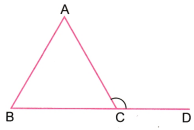
(a) ∠ACB
(6) ∠ABC
(c) ∠BAC
(d) ∠ACD
Question 14.
In the given figure, the interior opposite angles are
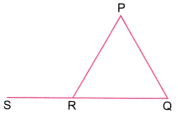
(a) ∠P and ∠R
(b) ∠Q and ∠P
(c) ∠Q and ∠PR
(d) ∠Q and ∠R
Question 15.
The measure of an exterior angle of a triangle is 120°. The interior opposite angles are equal. Then measure of each interior opposite angle is
(a) 60°
(b) 120°
(c) 30°
(d) 45°
Question 16.
What type of triangle has all three sides of different lengths?
(a) Equilateral Triangle
(b) Isosceles Triangle
(c) Scalene Triangle
(d) Right Triangle
Question 17.
In an isosceles triangle, how many angles are equal?
(a) One
(b) Two
(c) Three
(d) None of these
Question 18.
What is the sum of all angles in any triangle?
(a) 180 degrees
(b) 90 degrees
(c) 360 degrees
(d) 270 degrees
Question 19.
In a right-angled triangle, the side opposite to the right angle is called:
(a) Base
(b) Perpendicular D
(c) Hypotenuse
(d) Altitude
Question 20.
If the three angles of a triangle are 60 degrees each, what type of triangle is it?
(a) Scalene Triangle
(b) Isosceles Triangle
(c) Equilateral Triangle
(d) Obtuse Triangle
Assertion-Reason Questions
In questions 1 to 4, a statement of Assertion (A) is followed by a statement of Reason (R). Choose the correct option.
Question 1.
Assertion (A): A triangle cannot be formed with side lengths 5 cm, 5 cm, and 12 cm.
Reason (R): A triangle exists only when the sum of any two sides is greater than the third side.
(а) Both (A) and (R) are true, and (R) is the correct explanation of (A).
(b) Both (A) and (R) are true, but (R) is not the correct explanation of (A).
(c) (A) is true, but (R) is false.
(d) (A) is false, but (R) is true.
Question 2.
Assertion (A): All three altitudes of a triangle intersect at a single point called the orthocentre.
Reason (R): The point of concurrency of medians is the orthocentre.
(a) Both (A) and (R) are true, and (R) is the correct explanation of (A).
(b) Both (A) and (R) are true, but (R) is not the correct explanation of (A).
(c) (A) is true, but (R) is false.
(d) (A) is false, but (R) is true.
Question 3.
Assertion (A) : A triangle with angles 70°, 70°, and 70° can exist.
Reason (R) : The sum of all angles in a triangle must be 180°.
(а) Both (A) and (R) are true, and (R) is the correct explanation of (A).
(b) Both (A) and (R) are true, but (R) is not the correct explanation of (A).
(c) (A) is true, but (R) is false.
(d) (A) is false, but (R) is true.
Question 4.
Assertion (A): A triangle with side lengths 4 cm, 5 cm, and 8 cm exists.
Reason (R): The sum of the two smaller sides (4 + 5 = 9) is greater than the third side (8 cm).
(a) Both (A) and (R) are true, and (R) is the correct explanation of (A).
(b) Both (A) and (R) are true, but (R) is not the correct explanation of (A).
(c) (A) is true, but (R) is false.
(d) (A) is false, but (R) is true.
Fill in the blanks
1. A triangle has ______ elements.
2. A triangle in which exactly two sides are equal is an ______ triangle.
3. A triangle in which all sides are equal is a ______ triangle.
4. The sum of lengths of two sides of a triangle is _________ than the length of the third side.
5. A triangle with side lengths 8 cm, 10 cm and, 20 cm is not possible because 20 – 10 is _______
6. A triangle with side lengths 12 cm, 8 cm and, 3 cm is not possihie because 3 + 8 is _______
7. If the measure of an angle of a triangle is 100° then any of the other two angles is less than ______
8. The measures of the two angles of a triangle are 60° and 40°. The measure of the third angle is ______.
9. The acute angles of a right triangle are 40° and ______.
10. If the measure of an angle of a triangle is 1000 then any of the other two angles is less than ______
11. The measures of the two angles of a triangle are 60° and 40°. The measure of the third angle is ______.
12. The acute angles of a right triangle are 40° and ______
13. In the given figure, the value of ’x’ is ____________ .
14. In a ∆AEC, the measures of angles at A and B are 60° and 20°. Then the measure of the exterior angle at C is ______________ .

15. A triangle with all sides equal is called an _________.
16. A triangle with ______ sides is called an isosceles triangle.
17. A triangle with all angles less than ______ degrees is called an acute-angled triangle.
18. A triangle with one angle equal to 90 degrees is called a ______ triangle.
19. A triangle with one angle ______ than 90 degrees is called an obtuse-angled triangle.
Write (T) for true or (F) for false for the given statements
1. A triangle may have six or more elements.
2. In an equilateral triangle, the measure of each interior angle is 60°.
3. In an isosceles triangle, two interior angles will be equal.
4. A triangle with sides 8 cm, 12 cm and 20 cm is possible.
5. To construct a triangle we must know at least one side of the triangle.
6. The difference of the lengths of any two sides of a triangle is smaller than the length of the third side.
7. The acute angles of a right triangle are 300 and 60°.
8. A triangle can have two angles of 90° each.
9. Measures of two angles of a triangle are 61° and 39°. Then the measure of the third angle is 80°.
10. The acute angles of a right triangle are 30° and 60°.
11. A triangle can have two angles of 90° each.
12. Measures of two angles of a triangle are 61° and 39°. Then the measure of the third angle is 80°.
13. A right angled triangle can also be isosceles.
14. Every triangle with all angles less than 90° is called a scalene triangle.
15. A triangle with two equal angles must also have two equal sides.
Short Answer Type Questions
Question 1.
List all the elements of ∆XYZ.
Solution:
______________________________
______________________________
______________________________
Question 2.
Draw a rough figure of isosceles ∆ABC, with AB = AC. Mark the equal sides.
Solution:
______________________________
______________________________
______________________________
Question 3.
Draw a rough figure of equilateral A PQR. Mark the equal sides.
Solution:
______________________________
______________________________
______________________________
Question 4.
In the given figure, O is the center of the circle. Use 0 and points on the circle to form an isosceles triangle.
Solution:

Question 5.
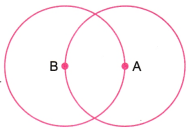
In the given figure, A, and B are the centres of circles of the same radius. Use A and B and the points where the circles meet to form isosceles and equilateral triangles.
Solution:
Question 6.
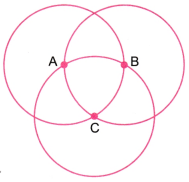
In the given figure, A, B, and C are the centres of circles of the same radius. Use A, B, and C and the points where the circles meet to form isosceles and equilateral triangles.
Solution:
Question 7.
Two sides of a triangle are 10 cm and 25 cm. Give five possible values for the third length so that there exists a triangle having these as side lengths.
Solution:
______________________________
______________________________
______________________________
Question 8.
Which of the following can be the sides of a triangle?
(a) 5 cm, 6 cm, 12 cm
(b) 10 cm, 12 cm, 23 cm
Solution:
______________________________
______________________________
______________________________
Question 9.
Between what two measures should the length of the third side of the triangle be if the lengths of the two sides are
(a) 8 cm and 12 cm
(b) 16 cm and 13 cm
Solution:
______________________________
______________________________
______________________________
Question 10.
Construct triangles with the following sets of side lengths:
Set A : 3 cm, 4 cm, and 8 cm
Set B : 5 cm, 6 cm, and 10 cm
Set C : 4 cm, 5 cm, and 6 cm
Check which sets can form a triangle. For those that cannot, show that the sum of the two shorter sides is not greater than the longest side. Use your observations to explain with the triangle inequality rule.
Solution:
______________________________
______________________________
______________________________
Question 11.
Construct ∆ABC in which AB = 7 cm, BC = 5.5 cm, and CA = 6.5 cm.
Solution:
______________________________
______________________________
______________________________
Question 12.
Construct ∆PQR such that PQ = 5 cm, QR = 3 cm, and ∠Q = 53°.
Solution:
______________________________
______________________________
______________________________
Question 13.
Construct ∆LMN, given ∠L = 45°, ∠M = 62°, and LM= 6 cm.
Solution:
______________________________
______________________________
______________________________
Question 14.
Construct the right-angled ∆XYZ, where ∠Y = 90°, XZ = 8 cm, and XY = 4.5 cm.
Solution:
______________________________
______________________________
______________________________
Question 15.
Construct a right triangle with hypotenuse 8 cm and one of the sides 5.4 cm. How many different triangles exist with these measurements?
Solution:
______________________________
______________________________
______________________________
Question 16.
Construct an obtuse-angled isosceles triangle.
Solution:
______________________________
______________________________
______________________________
Question 17.
Construct a right-angled isosceles triangle.
Solution:
______________________________
______________________________
______________________________
Question 18.
Find the third angle of a triangle (using a parallel line) when two of the angles are: 36° and 72°.
Solution:
______________________________
______________________________
______________________________
Question 19.
In ∆ABC, ∠B = ∠C and ∠A = 50°. Find ∠B and ∠C.
Solution:
______________________________
______________________________
______________________________
Question 20.
The three angles of a triangle are equal to one another. What is the measure of each angle?
Solution:
______________________________
______________________________
______________________________
Question 21.
Find the measure of the angle of a triangle if one of the angles is 140° and the other two angles are equal.
Solution:
______________________________
______________________________
______________________________
Question 22.
The measure of an angle is 50°. Find another angle for which a triangle is (a) possible, (b) not possible. Find at least two different angles for each category.
Solution:
______________________________
______________________________
______________________________
Question 23.
Determine which of the following pairs can be the angles of a triangle, (a) 40°, 145° (b) 70°, 30°
Solution:
______________________________
______________________________
______________________________
Question 24.
Can you construct a triangle all of whose angles are equal to 61°? If two of the angles are 61°, what would the third angle be?
Solution:
______________________________
______________________________
______________________________
Question 25.
In ∆PQR, the measure of an exterior angle is 105° and one of the opposite interior angles is 45°, find the measure of another opposite interior angle.
Solution:
______________________________
______________________________
______________________________
Question 26.
One of the exterior angles of a triangle is 110°. The interior opposite angles are equal to each other. Find the measure of these equal interior opposite angles.
Solution:
______________________________
______________________________
______________________________
Question 27.
An exterior angle is 100° and the interior opposite angles differ by 10°. Find all the angles of the triangle.
Solution:
______________________________
______________________________
______________________________
Question 28.
Construct ∆ABC in which AB = 5.5 cm, BC = 6.5 cm, and CA = 6.8 cm. Construct an altitude from A to BC.
Solution:
______________________________
______________________________
______________________________
Question 29.
Construct ∆PQR such that PQ = 5.8 cm, QR = 6.7 cm and ∠Q = 72°. Construct an altitude from R to PQ.
Solution:
______________________________
______________________________
______________________________
Question 30.
Construct ∆LMN, given ∠L = 40°, ∠M = 55° and LM= 8.4 cm. Construct an altitude from L to MN.
Solution:
______________________________
______________________________
______________________________
Question 31.
Construct the right-angled ∆XYZ, where Y = 90°, XZ = 7 cm and XY = 4.5 cm. Construct an altitude from Y to ZX.
Solution:
______________________________
______________________________
______________________________
Question 32.
One of the acute angles of a right-angled triangle is 50°. Find the other acute angle.
Solution:
______________________________
______________________________
______________________________
Question 33.
If two angles of a triangle are 65° and 45°, then find the third angle.
Solution:
______________________________
______________________________
______________________________
Question 34.
If the angles of a triangle are in the ratio 2:3:4, then find the three angles of the triangle.
Solution:
______________________________
______________________________
______________________________
Question 35.
The sum of two angles of an isosceles triangle is equal to it’s third angle. Determine the measures of all the angles.
Solution:
______________________________
______________________________
______________________________
Case Based Questions
Kanishka wanted to draw a triangle with AB = 5 cm, ∠A = 60°, and ∠B = 70°. She wanted to find the third angle before construction and was also curious whether any triangle is possible if the sum of two angles is more than 180°.
Question 1.
What is the sum of angles in any triangle?
(a) 180°
(b) 360°
(c) 90°
(d) Depends on the triangle
Question 2.
If ∠A = 60° and ∠B = 70°, what is the measure of ∠C?
(a) 60°
(b) 50°
(c) 40°
(d) 30°
Question 3.
Can a triangle exist if the two given angles are 90° and 100°?
(a) Yes
(b) No
(c) Only if the side is small
(d) Only if all sides are equal
Question 4.
In a triangle where ∠A = 45° and ∠B = 80°, how can the third angle ∠C be determined?
(a) Subtract their sum from 180°
(b) Average the two angles
(c) Add their values
(d) Construct the triangle and measure