Practicing Class 8 Maths MCQ and Class 8 Maths Chapter 1 A Square and A Cube MCQ Questions Online Test with Answers daily helps in time management.
MCQ on A Square and A Cube Class 8
A Square and A Cube MCQ Class 8
Class 8 Maths MCQ Chapter 1 A Square and A Cube
Multiple Choice Questions
Question 1.
The square of \(\sqrt{4 \times 25}\) is
(a) 100
(b) 10
(c) 20
(d) 50
Answer:
(a) 100
Question 2.
(2535)2 – (2534)2 is equal to
(a) 5069
(b) 8839
(c) 1
(d) 6423690
Answer:
(a) 5069
Question 3.
The smallest number, which when added to the difference of the squares of 17 and 13 gives a perfect square, is
(a) 1
(b) 2
(c) 4
(d) 5
Answer:
(a) 1

Question 4.
Which of the following is not a perfect square?
(a) 196
(b) 625
(c) 1225
(d) 404
Answer:
(d) 404
Question 5.
The smallest natural number by which 32 must be multiplied to get a perfect cube is
(a) 16
(b) 4
(c) 2
(d) 8
Answer:
(c) 2
Question 6.
\(\sqrt[3]{8 \times 64}\) = ?
(a) 12
(b) 16
(c) 8
(d) 24
Answer:
(c) 8
Question 7.
If the volume of a cube is 729 cm3, then the length of its side is
(a) 8 cm
(b) 9 cm
(c) 7 cm
(d) 6 cm
Answer:
(b) 9 cm
Assertion-Reason Based Questions
In the following questions (8-10), a statement of Assertion (A) is followed by a statement of Reason (R). Choose the correct option as:
(a) Both Assertion and Reason are true and Reason is the correct explanation of Assertion.
(b) Both Assertion and Reason are true but Reason is not the correct explanation of Assertion.
(c) Assertion is true but Reason is false.
(d) Assertion is false but Reason is true.
Question 1.
Assertion (A): Between 60 and 70, the perfect square number is 65.
Reason (R): A perfect square is a number that can be expressed as the product of an integer by itself.
Answer:
(d) Assertion is false but Reason is true.
Question 2.
Assertion (A): The number of zeros in the square of the number 9000 is 6.
Reason (R): The number of zeros at the end of a square of a number is twice the number of zeros at the end of the number.
Answer:
(a) Both Assertion and Reason are true and Reason is the correct explanation of Assertion.
Question 3.
Assertion (A): Every perfect square ends with 0, 1, 4, 5, 6, or 9.
Reason (R): The units digit of a square depends only on the units digit of the original number.
Answer:
(b) Both Assertion and Reason are true but Reason is not the correct explanation of Assertion.
Fill in the blanks:
1. The square of an even number is always …….. .
Answer: Even
2. A number ending in 2, 3, 7 or 8 is never a …….. .
Answer: Square number
3. √49 + √36 + √16 – √9 = …….. .
Answer: 14
4. The sum of the first n odd natural numbers is …….. .
Answer: n2
5. Square of 87 will end with the digit …….. .
Answer: 9
State whether the following statements are True or False.
1. The cube of any even number is odd.
Answer: False
2. The cube of a 2 – digit number may have six digits.
Answer: True
3. (512)13 = 8.
Answer: True
4. The least number by which 648 should be divided to get a perfect cube is 2.
Answer: False
Fun Activity
1. Play this Tic-Tac-Toe game, with your friends.
Take the turns alternatively, solve the given problem and acquire the box.
The player who marks three of their boxes in a line (horizontal, vertical, or diagonal) is the winner.
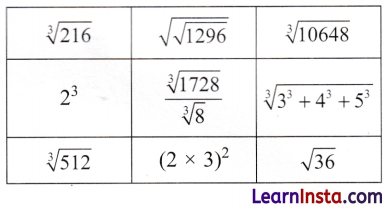
Answer:
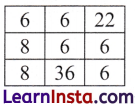
Do as Directed
Question 1.
If 3 p = √122 + 92, then p3 = ?
Answer:
\(\frac{5}{3}\)
Question 2.
If area of a square is 12 \(\frac{1}{4}\) cm2, then what will be its perimeter?
Answer:
14cm
Question 3.
9216 plants are to be planted in a garden in such a way that each row contains as many plants as the number of rows. Find the number of rows and number of plants in each row.
Answer:
96; 96
Question 4.
The student of class VIII of a school donated ₹ 10,201 in all to Prime Minister Relief Fund. If each student donated as much amount as the number of students. Find the number of students.
Answer:
101
Question 5.
Evaluate the following:
(a) \(\sqrt[3]{36}\) × \(\sqrt[3]{384}\)
Answer:
24
(b) \(\sqrt[3]{2592}\) × \(\sqrt[3]{144}\)
Answer:
72
Question 6.
Observe the following pattern:
23-13 = 1 + 3(2 × 1)
33-23 = 1 + 3(3 × 2)
43-33 = 1 + 3(4 × 3)
Using this pattern, find the value of each of the following:
(a) 803 – 793
(b) 1013 – 1003
Answer:
(a) 18961
(b) 30301
Question 7.
Find the smallest number by which 26244 should be divided so that the quotient is a perfect cube. Also, find the cube root of the quotient so obtained.
Answer:
36; 9
Question 8.
Sumit is studying in class VIII of a reputed school. He is very good at sports too. He was playing two games for his school team, Taekwondo and Kabaddi. His Taekwondo court is of square shaped area = 144 m2; while his Kabaddi court is of rectangular shape whose length is 3 m more than its breadth. The perimeter of the kabaddi court is 5 m longer than that of the taekwondo court.
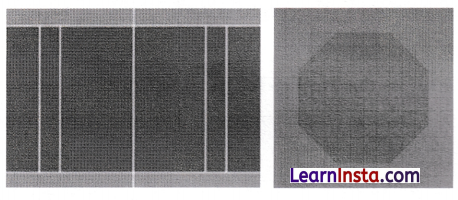
(a) Determine the length of each side of square shaped Taekwondo court.
Answer:
12m
(b) What is the length of Kabaddi court?
Answer:
14.75m
(c) Find the area of the Kabaddi court.
Answer:
173.3125m2
(d) Write the perfect square which lie between the area of taekwondo court and that of the Kabaddi court.
Answer:
169