Experts have designed these Class 7 Maths Notes and Chapter 3 A Peek Beyond the Point Class 7 Notes for effective learning.
Class 7 Maths Chapter 3 Notes A Peek Beyond the Point
Class 7 Maths Notes Chapter 3 – Class 7 A Peek Beyond the Point Notes
The Need for Smaller Units Class 7 Notes
Smaller units are needed for precise measurements, especially when dealing with objects that are small or require accuracy. For example, instead of measuring the length of a pencil in kilometers, we use centimeters or even millimeters, which are smaller units of length, to achieve a more accurate measurement.

A Tenth Part Class 7 Notes
When a whole is divided into ten equal parts, each part is called one-tenth. It is written as \(\frac{1}{10}\).
For example, if a pencil is 3 cm and 6 mm long, we can write the length as 3\(\frac{6}{10}\) cm (which is 3 whole centimeters and 6-tenths of a centimeter or 6 mm).
In a cm scale, the distance between two consecutive cm is split into 10 divisions, each division is \(\frac{1}{10}\) of a cm.

A Hundredth Part Class 7 Notes
When a whole is divided into 100 equal parts, each part is called one-hundredth. It is written as \(\frac{1}{100}\).
For example, 99 paise is the same as ₹ \(\frac{99}{100}\), where ₹ 1 is divided into 100 equal parts, each part representing one-hundredth of a rupee.
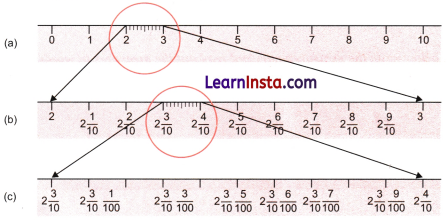
When we see scale (a) under the lens, we observe that the gap between 2 and 3 is divided into 10 parts.
We see scale (b) under the lens, we observe that the gap between 2\(\frac{3}{10}\) and 2\(\frac{4}{10}\) is divided into 10 parts.
Thus, we note that each one-tenth can be divided into 10 parts, each part is then one-hundredth of the whole.
Ten one-hundredths make one tenth
\([latex]\frac{1}{10}\)[/latex]
1 cm = \(\frac{10}{10}\) cm
or 1 cm = \(\frac{100}{100}\)
4 cm = 400 × \(\frac{1}{100}\) or 400 one-hundredths.
Adding Numbers in Hundredths
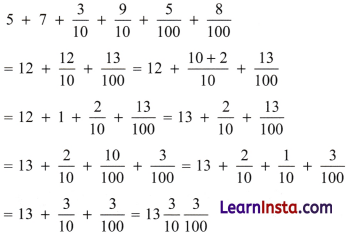
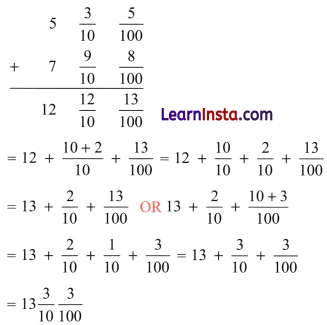
Add whole to whole, tenth to tenth, and hundredth to hundredth
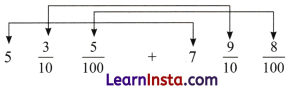
Method 1:
Method 2:
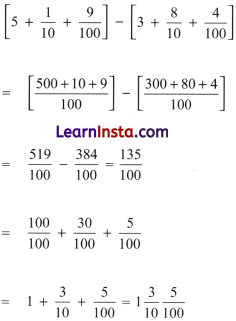
Solve \(5 \frac{1}{10} \frac{9}{100}-3 \frac{8}{10} \frac{4}{100}\).
Solution:
We have
Decimal Place Value Class 7 Notes
In previous classes, we learnt about the number system.
10 ones = 1 tens
10 tens = 1 hundreds
10 hundreds = 1 thousand and so on ….
What if we divide 1 one into ten parts?
1 when split in ten parts gives \(\frac{1}{10}\) or one-tenth.
One tenth i.e., \(\frac{1}{10}\) when divided in 10 parts gives \(\frac{1}{10 \times 10}=\frac{1}{100}\) or one-hundredth.
432 = 4 × 100 + 3 × 10 + 2 × 1
As we move from left to right, we note that each position is one-tenth of the previous one. So, when we move from 100’s position the immediate right is 10’s position and the next right is 1’s position on further moving we note that next position is \(\frac{1}{10}\)th and the next to it is \(\frac{1}{100}\)th position.

Notation, Writing, and Reading of Numbers
To represent one-tenth, one-hundredth, and one-thousandths in a number, we use a decimal as a separation from whole numbers.
17.25 = 1 tens + 7 ones + 2 tenth + 5 one hundredth
= 10 + 7 + \(\frac{2}{10}\) + \(\frac{5}{100}\)
1.725 = 1 ones + 7 tenth + 2 hundredth + 5 thousandth
Understanding Numbers in the Place Value Systems

406.27 is read as four hundred six point two seven.
415.6 is read as four hundred one tens five point six.
Units of Measurement Class 7 Notes
Length Conversion
We know 1 cm = 10 mm using the same conversion to express lengths in decimal.
56 mm = ?
1 mm = \(\frac{1}{10}\) cm = 0.1 cm
56 mm = \(\frac{56}{10}\) cm
= \(\frac{50}{10}+\frac{6}{10}\)
= 5 + \(\frac{6}{10}\)
= 5.6 cm
Other Conversion
1 km = 10 hm
1 hm = 10 dam
1 dam = 10 m
1 m = 10 dm
1 dm = 10 cm
1 cm = 10 mm
Let us now convert 856 cm in m.
1 cm = \(\frac{1}{100}\) m
So,
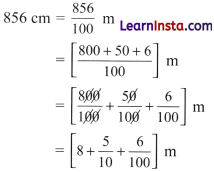
= [8 ones 5 tenth 6 hundredth] m
= 8.56 m
Locating and Comparing Decimals Class 7 Notes
Locating and comparing decimals involves using a number line or place value, or scale to determine the relative position and value of decimals. When comparing, you start by comparing the whole number parts, then the tenths place, then the hundredths place, and so on, until a difference is found.
Addition and Subtraction of Decimals Class 7 Notes
To add or subtract decimals, line up the decimal points vertically and then add or subtract as you would with whole numbers, ensuring the decimal point in the answer aligns with the others.